
My Automated Competitive SEO Monitoring Stack with Hermes
Following 100 X accounts, browsing Product Hunt every morning, not missing the latest trending Show HN, and also trying to keep an eye on what your direct competitors are publishing… Before Hermes, I was honestly drowning. I’d open 15 tabs, scroll until my thumb hurt, and by evening I’d realize I’d missed the essentials. So I decided to vibecode my own automated competitive monitoring stack with Hermes Agent. Here’s exactly how I built it, what it scrapes, how it filters, and why you don’t need to be a developer to do the same.
Why manual monitoring became unsustainable
When you follow 99 X accounts in SEO, SaaS, and entrepreneurship (because X caps your following at 100, thanks algorithm), you end up with a timeline running at 200 tweets/hour. Add Product Hunt dropping 30 to 50 new products daily, and Show HN posting open-source projects every 15 minutes.
Result: in 2024, I spent the equivalent of 12 full days scrolling aimlessly. 12 days. Reading stuff I’d forget 2 hours later.
The real problem isn’t the volume of information. It’s the filtering. Separating signal from noise, spotting what actually deserves an article or a strategic note. And that, a human alone cannot do at scale.
The architecture of my automated competitive monitoring with Hermes
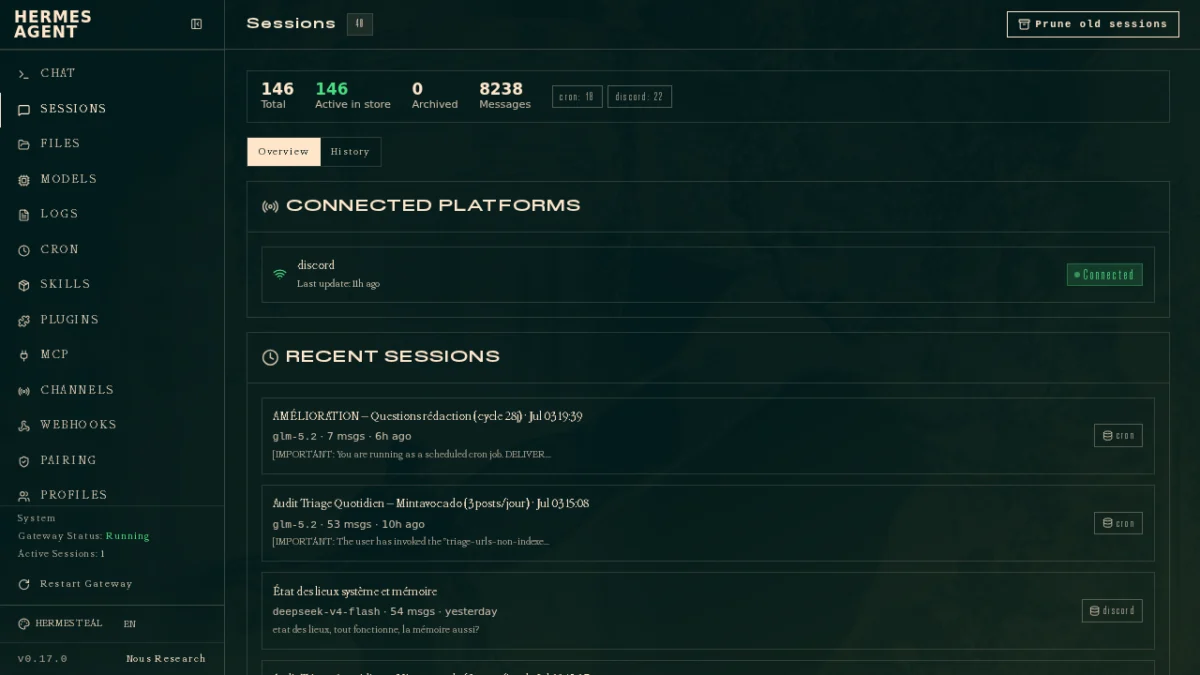
Here’s the schematic of my stack. It’s a pure Hermes orchestration, with no heavy custom code.
The brain: Hermes Agent + Palta
Palta is the Hermes Agent orchestrator. It coordinates all sub-agents. Instead of having 15 scripts running on their own that nobody dares touch, I have a modular structure where each component is an independent agent.
“`
┌─────────────────────────────────────────────────┐
│ Palta Orchestrator (Hermes Agent) │
│ ├─ multi_watchdog.py (scraping & filtering) │
│ ├─ X Collection Agent (99 accounts rotating) │
│ ├─ Product Hunt Agent (RSS → articles) │
│ ├─ Hacker News Agent (Show HN) │
│ └─ Synthesis Agent (summary + relevance score) │
│ │
│ Delivery at 8am → Discord webhook │
│ Human validation → Editorial pipeline │
│ → Writing sub-agent → WordPress API │
└─────────────────────────────────────────────────┘
“`
The sources: where I fetch the info
X/Twitter (99 following accounts)
I identified the key accounts in my niche: indie SEO experts, SaaS founders, build in public addicts. The `multi_watchdog.py` runs in stealth scraping mode via Scrapling MCP: an MCP that handles JavaScript rendering and bypasses anti-bot protections. Result: tweets arrive with no rate limits, no captchas, no headaches.
I sorted them into three buckets:
Product Hunt (RSS)
Product Hunt still has a functional RSS feed. I parse it with a simple Hermes sub-agent that turns each entry into a structured card: name, tagline, upvotes, link. No complicated scraping, no JavaScript.
Hacker News (Show HN)
Show HN is the hidden gem. Open-source projects and newborn SaaS get posted there before going anywhere else. My HN agent fetches the top posts from the last 24 hours, filters by keywords (automation, AI, SEO, productivity tools) and gives me a shortlist.
How multi_watchdog.py filters relevance
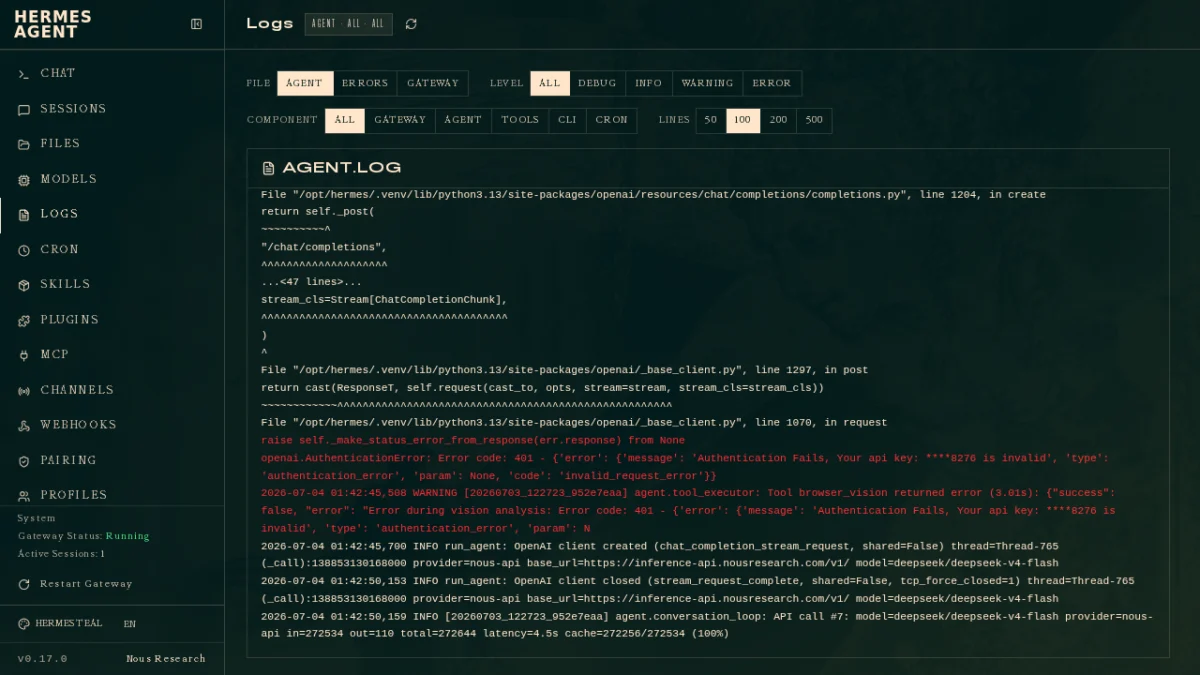
This is the heart of the stack. Without it, I’d have a mountain of raw data. With it, I receive 5 to 10 proposals per day, at least 4 of which are actually actionable.
The scoring criteria
The watchdog scores each item on 4 axes:
| Criteria | Weight | Match example |
|---|---|---|
| Solopreneur relevance | 40% | “tool for freelancers”, “boost your productivity” |
| Automation | 25% | “no-code”, “workflow”, “AI agent”, “scraping” |
| Affiliation & monetization | 20% | “partner program”, “commission”, “passive income” |
| Freshness & virality | 15% | less than 24h, upvotes, retweets |
A score > 70% triggers a notification. Between 50 and 70%, it goes into a weekly digest. Below that, trash.
This system saves me from having to check 47 times a day whether a competitor launched a new feature. The watchdog does it for me.
The concrete implementation
No speed contest. Here’s the actual YAML config:
“`yaml
watchdog:
sources:
twitter:
enabled: true
accounts_file: “twitter_following_99.json”
rotation_strategy: “priority_standard_scan”
interval_minutes: 120
product_hunt:
enabled: true
rss_url: “https://www.producthunt.com/feed?category=tech”
interval_minutes: 360
hacker_news:
enabled: true
endpoint: “https://hacker-news.firebaseio.com/v0/showstories.json”
interval_minutes: 480
scoring:
threshold_notify: 70
threshold_digest: 50
keywords:
– “solopreneur”
– “automation”
– “affiliation”
– “agent”
– “hermes”
delivery:
discord_webhook: “https://discord.com/api/webhooks/…”
schedule: “0 8 * * *”
“`
You replace the values, push to your VPS, and it’s ready. Zero lines of code modified.
The daily pipeline: from monitoring to article
Once the proposals arrive on Discord every morning at 8am, my workflow looks like this:
1. Human validation (5 min)
I scan the day’s shortlist. 3 clicks in Discord:
2. Automatic writing pipeline
When I validate a topic, a Hermes sub-agent triggers a pipeline:
- Deep research: scrapes the associated sources (original article, tweets, comments)
- Article structure: generates an SEO outline (H1, H2, H3, keywords)
- First draft writing: using the Laurent persona (my persona: pedagogical sherpa, build in public tone)
- Post-editing: checks links, Gutenberg structure, SEO tags
3. Publication via WordPress API
The final draft is pushed automatically to WordPress via the REST API. All I have to do is proofread and click “Publish”.
Result: a 2000-word SEO article goes from raw idea to publication in less than 30 minutes of my time. Versus 3-4 hours before.
The detailed technical stack
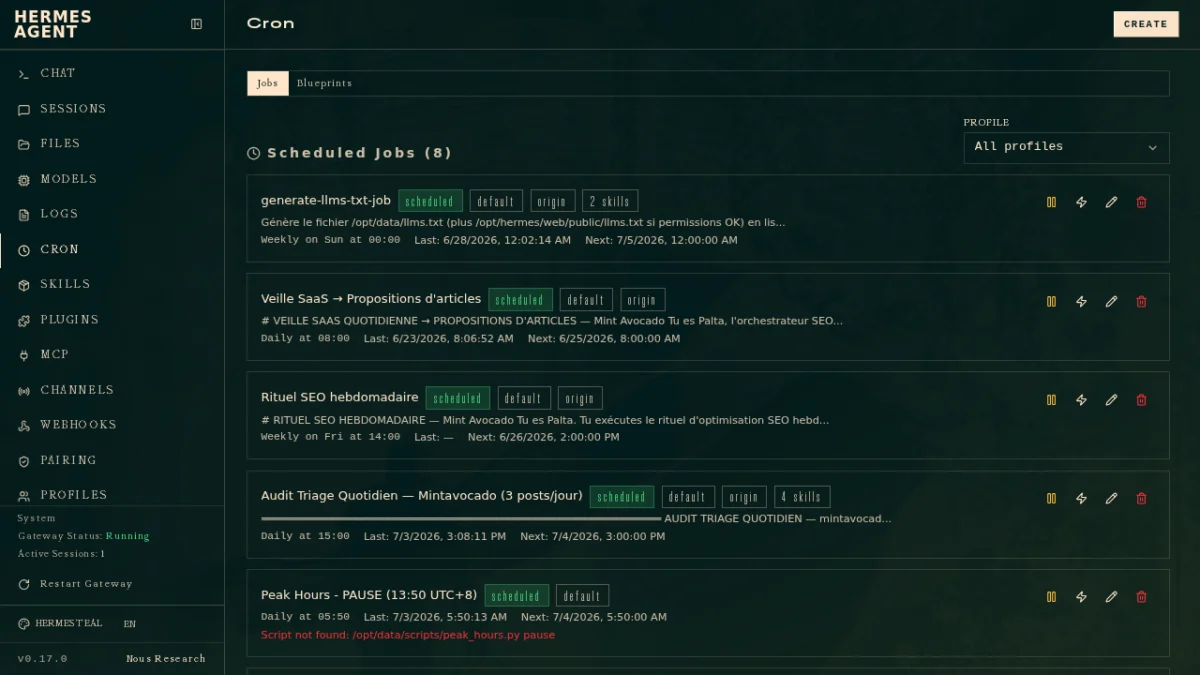
For the curious ones who want the technical vibe, here’s the backbone:
| Layer | Technology | Why |
|---|---|---|
| Orchestrator | Hermes Agent + Palta | Sub-agent coordination, triggers, pipeline |
| Stealth scraping | Scrapling MCP | Avoids X blocks, native JS rendering |
| Server | VPS (DigitalOcean / Hetzner) | 24/7, Cron jobs, $5/month is enough |
| Storage | Local JSON + SQLite | No need for a heavy database for text |
| Delivery | Discord Webhook | Free, mobile, instant notifications |
| CMS | WordPress API | The SEO standard, Yoast/RankMath plugins |
| LLM sub-agents | Hermes models (via provider) | Writing, summarization, classification |
What I love about this stack is that every brick is replaceable. You can swap Scrapling for something else, Discord for Slack, WordPress for Notion. The Hermes orchestrator handles the abstraction.
Why you don’t need to be a developer
This is the question everyone asks me. The answer is simple: Hermes Agent is designed for solopreneurs, not engineers.
If you know how to write a 15-line `.json` file, you can set up this automated competitive monitoring with Hermes in a weekend.
I started with exactly zero Python experience. Today, I have 14 Hermes pipelines in production. The secret is to vibecode: launch, break, iterate. The AI explains every error to you.
What this has brought me concretely
After 3 months with this stack:
| Before | After |
|---|---|
| 45 min of monitoring every morning | 5 min of validation |
| 1 SEO article / week | 3-4 articles / week |
| I missed 60% of good info | I no longer miss anything major |
| 4h of writing per article | 30 min of human work |
| Stress of “I missed something” | Peace of mind, the watchdog is running |
The real game-changer: I’m no longer in reaction mode. Before, I’d discover trends 2-3 days after everyone else. Now, I’m on topics within hours of their emergence. In SEO, that’s the difference between an article that ranks and an article that gathers dust.
Pitfalls to avoid if you reproduce this stack
I made the mistakes so you don’t have to. Here are the most costly ones:
1. Trying to scrape too many sources
I started with 15 different sources (Medium, Reddit, LinkedIn, blogs, newsletters…). Result: hundreds of items per day, the filter was saturated, and I ended up ignoring everything. 3 well-targeted sources are better than 15 skimmed ones.
2. Not adjusting the scoring weights
My first scores were too strict. Nothing passed the 70% threshold. I spent a week fine-tuning: lowering the virality weight, raising the solopreneur relevance one. Iterate on your thresholds for 2 weeks before trusting the system.
3. Neglecting X token rotation
Scraping Twitter/X requires a bit of finesse. With Scrapling MCP in stealth mode, I use session and user-agent rotation. If you force a single window, X will rate-limit you after 30 requests. Rotation is key.
4. Trying to automate human validation
I tried it. I set up an agent that automatically published articles scoring above 80%. Result: 3 disastrous articles (including one about a tool I hadn’t even tested). Human validation is sacred. The pipeline can write, but the final decision remains human.
Where to start tomorrow morning
If you want to set up your own automated SEO monitoring, here are the first 3 actions:
- Install Hermes Agent on a $5/month VPS → 15 minutes flat
- Enable the Scrapling MCP in your Hermes config → it’s a pre-integrated plugin
- Create your first watchdog with a single source (Product Hunt RSS) and test Discord delivery
You’ll have a first functional result in less than 2 hours. Then you add X, then Hacker News, then adjust the scores.
The hardest part isn’t the tech. It’s deciding what truly deserves your attention. Hermes doesn’t make that choice for you: it simply gives you the means to exercise your judgment where it counts.
What’s next? My stack’s roadmap
I’m currently adding two bricks:
As soon as it’s operational, I’ll do a build in public follow-up: as usual.



Leave a Reply