
How to Relaunch an Expired Domain: Complete SEO Guide 2025
To Start With: Why Are Expired Domains Such a Powerful SEO Lever?
Let me be direct with you: after testing dozens of SEO strategies, expired domains remain one of the most effective techniques to speed up a website’s positioning. Contrary to what some digital marketing “gurus” tell you, this method still works in 2025, but it demands rigor and a methodical approach.
Since I started building my side business, I quickly understood that waiting 6 to 12 months to see the first SEO results with a brand new domain was not compatible with my family goals. Between my classes in the morning and my evenings spent writing, every minute counts.
Expired domains keep their full history: backlinks, domain authority, residual traffic and sometimes even positions in the search results. This preservation of the “SEO heritage” is the main asset of the strategy. Instead of starting from zero, you capitalize on years of SEO work already done.
However, beware of dream sellers who promise miraculous results with no effort. Google tightened its rules in 2024, specifically targeting expired domain abuse. Thematic continuity and content consistency have become necessary factors to avoid penalties.
What Is an Expired Domain and How Does the Expiration Process Work?
An expired domain is a domain name that its owner did not renew by the due date. Contrary to popular belief, you do not own a domain forever – the registration has to be renewed every year.
The expiration process goes through several distinct phases that I learned the hard way. After the due date, the domain first enters a grace period during which the owner can still renew it at no extra cost. This period lasts about 30 days for a .COM and 21 days for a .FR.
A redemption period with higher fees follows, then the final deletion that makes the domain available for acquisition. That is the exact moment when investors like us can grab these gems.
During my learning phase, which is still going on today, I discovered that these domains often keep their existing revenue streams, their backlinks and their SEO value. Investors buy them through domain backorder services or online forums specialized in the secondary domain market.
The Essential Criteria for Picking a High-Performing Expired Domain
Non-Negotiable Metrics From My Experience
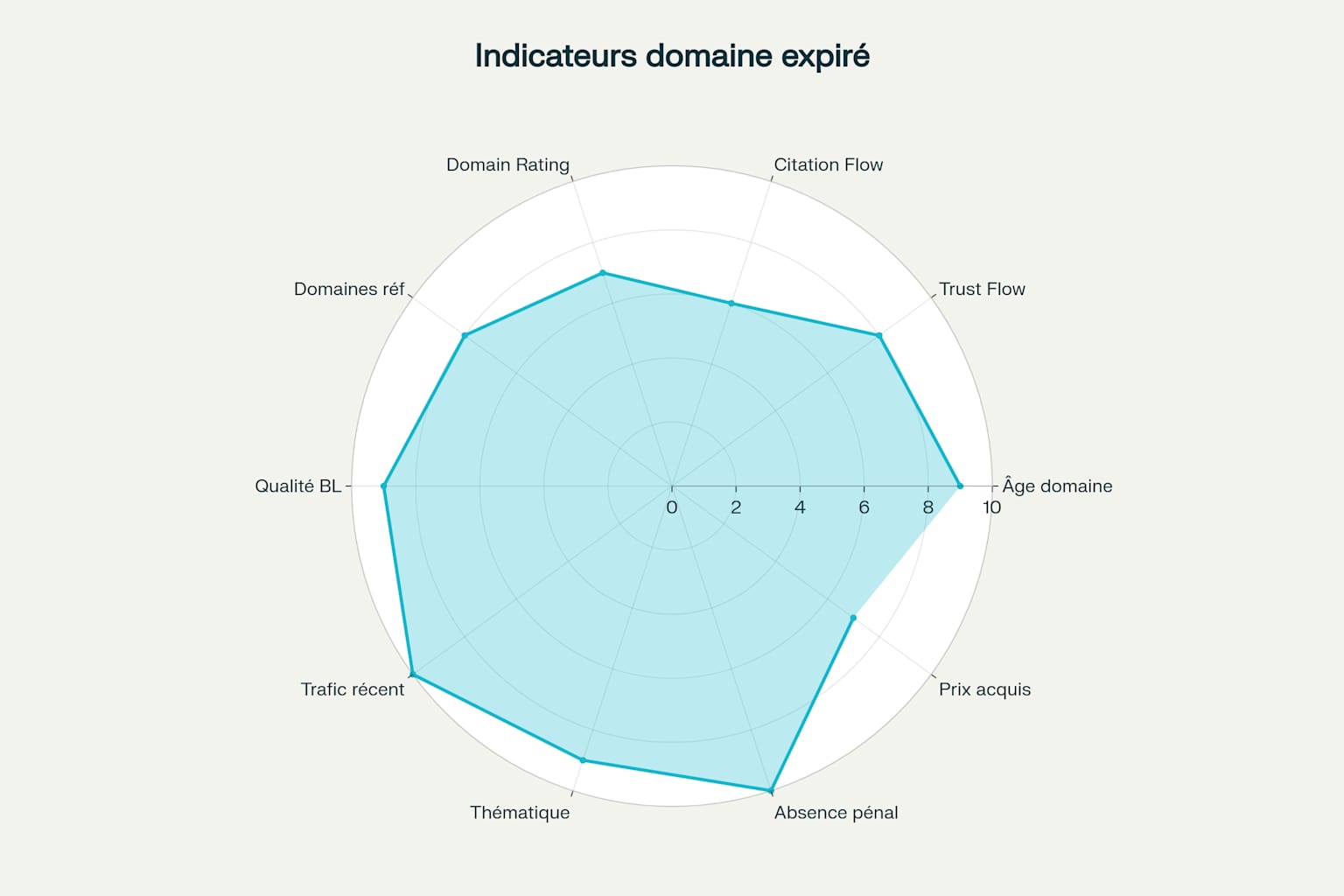
After analyzing hundreds of expired domains, I set my non-negotiable criteria. Recent traffic is the deciding factor: a gap of less than 6 months is ideal, with one year as the tolerable maximum. That short time gap maximizes the chances of keeping the authority and rankings already earned.
As for referring domains, I always favor quality over quantity. I look for sites “that will bounce back” rather than domains that simply show impressive numbers. This qualitative approach avoids the traps of metrics artificially inflated by low-value links.
My maximum budget is 150 euros per domain, often much less. Above that threshold, the investment has to be justified by exceptional potential. This budget cap lets me keep an acceptable risk/reward ratio while avoiding the bidding wars often seen on auction platforms.
Valuation Tools I Use Every Day
For my analyses I use several complementary platforms. expireddomains.net helps me spot, analyze and grab domains nearing expiration with excellent SEO authority. They go through third-party platforms. Registration, browsing and ordering are free – only the domain you get is billed.
ExpireSEO already does part of the selection work by listing only quality expired domain names with relevant inbound links. The site sorts available domains by industry and lets you rank them by Trust Flow, Citation Flow, Referring Domain and price.
For technical valuation I use the market-recognized SEO metrics from Semrush, Moz and Majestic. These tools let me find domains based on my target keywords, anchor texts and Topical Trust Flow.
Comparison of the Platforms Offering Expired Domains
| Platform | Extensions | Starting price | System | Metrics provided | Specialization | Success rate |
| KifDom | .fr only | €30.00 | Auctions | KifRank, TF, RD | French SEO | Medium |
| WebExpire (formerly DomExpire) | .fr mostly | €30.00 | Auctions/Backorder | TF, CF, DR, Backlinks | French SEO | High |
| Bloomup | Various extensions | €30.00 | Backorder/Auctions | Full SEO metrics | International SEO | Variable |
| YouDot | 9 extensions (.com, .fr, .org, etc.) | Variable | Auctions | Full metrics | French SEO | High |
| Expired Domains | Various extensions | Variable | Self-service | Basic metrics | International market | Variable |
Step-by-Step Process to Relaunch an Expired Domain
Acquisition Phase and Technical Preparation
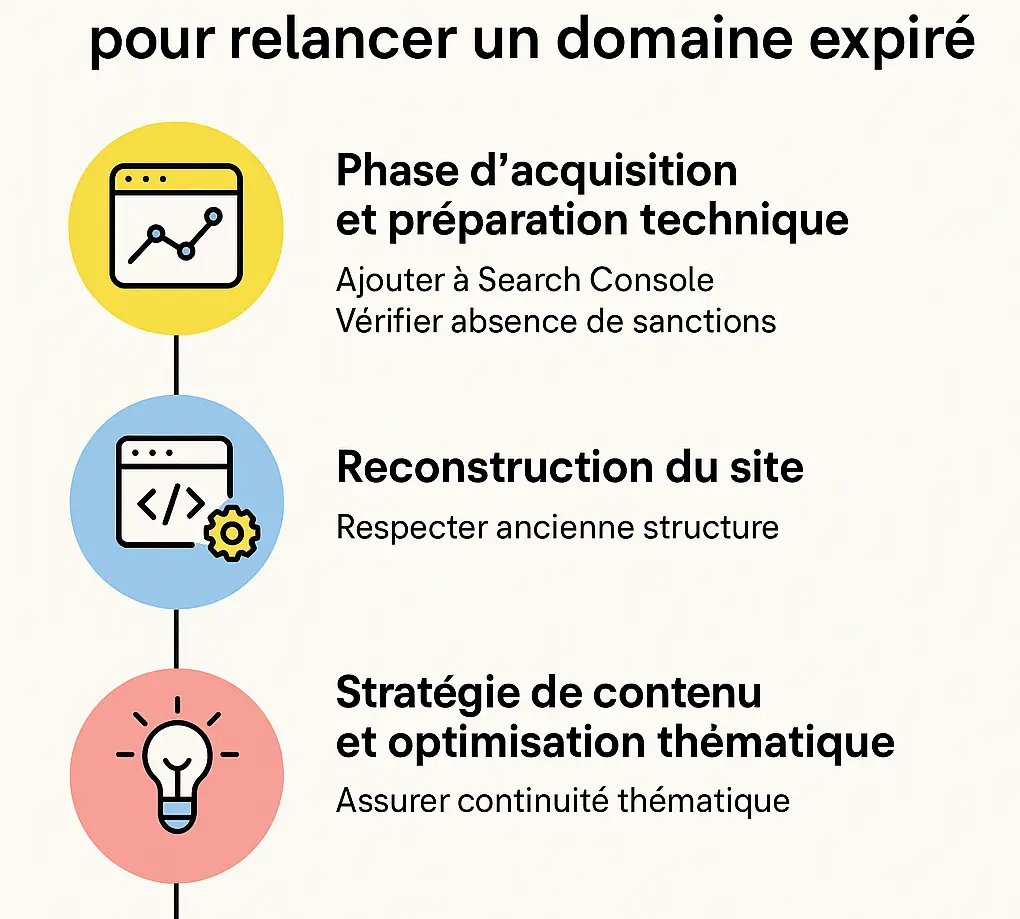
Acquisition starts with adding the domain to Google Search Console right away. This crucial step lets me recover historical data on the previous site’s performance and queries. Access to the old metrics makes the rebuild phase much easier by identifying the best-performing pages.
I always check for penalties in Search Console as soon as I buy. If the domain was penalized, a good recovery platform refunds me, though I can still disallow toxic links.
Recovering the original content relies on two main methods I have tested. Otomatic combined with the Freudix technique is my first approach, largely automating the recovery process. Web Resurrect by Mattioo81 is the alternative, built specifically to bring expired domains back to life.
Rebuilding the Site: Stick as Close to the Original as Possible
My priority is to stay as close as possible to the old site. That fidelity maximizes the chances of keeping SEO authority and helps Google reindex faster. My checklist requires bringing back ALL pages, even those with no backlinks or traffic.
I always keep the URL slugs, made easy by plugins such as Permalink Manager. This consistency in the URL structure preserves the value of existing backlinks and avoids 404 errors that would dilute the authority passed on.
Rewriting all the content is a legal and SEO obligation that I follow scrupulously. This step avoids copyright issues while letting me optimize the content for my target keywords. I use artificial intelligence to speed up the process while keeping quality high.
TIP from Julien at PIMPTONSEO: for every image backlink, redirect it to the homepage. A great tip that saved me a lot of backlinks!
Content Strategy and Thematic Optimization
Thematic Consistency: The Key to Success
Thematic consistency with the old site maximizes how well authority transfers. If I pick up a domain about a pizzeria in Montlucon, I write about pizza, Italian food and the region, respecting the original theme.
This strategy avoids brutal thematic shifts that could alert Google’s algorithms. The March 2024 update specifically targets “expired domain abuse”, where content unrelated to the original theme is published only to manipulate rankings.
Google now clearly separates legitimate uses from abusive practices. Using an old domain for a new, original site “designed to serve people first” is still allowed. On the other hand, exploiting a domain’s past reputation for unrelated content is treated as spam.
Keyword Tactics
I favor a counter-intuitive approach copied from the pros: “lots of small volumes (under 5k) > few big volumes”. This strategy has several advantages I have seen in my own projects. It avoids direct competition on the most contested keywords, and if one page drops, the impact on overall traffic stays limited. It also pairs well with a clear grasp of query fan-out in SEO, where a single query splits into many intents you can cover on one page.
My philosophy: lots of small volumes generate steadier traffic that depends less on one page’s performance. That diversification fits perfectly with a gradual growth strategy.
Design and Technical Aspects: The Minimalist Approach
My Pragmatic Philosophy
I take a minimalist approach to the initial design. This “less is more” philosophy puts function ahead of looks during the test phase. The free version of the Greenshift theme is more than enough until the site proves its potential, and it delivers solid web performance, so there is no need to shoot yourself in the foot.
This pragmatic approach avoids premature spending on design. If the domain takes off, a more elaborate design can come later. If not, the limited investment keeps my losses small.
Automation and Content Publishing
To publish easily across all my sites, I use Otomatic, which lets me generate quality content at scale. The platform keeps thematic relevance while automating most of the process. The recommended pace of 1 or 2 articles per day drives steady, gradual growth.
Automation does not excuse me from quality oversight. Every piece of content has to meet Google’s standards for expertise, authority and trust. Artificial intelligence speeds up my production but does not replace my human supervision.
TIP: check the competition, the search intent, the number of images per page for example, you will not rank with a single image if you compete on product reviews where everyone has between 6 and 8 images…
Evaluating Results and Making the Call
The Crucial 30 Days: Patience and Observation
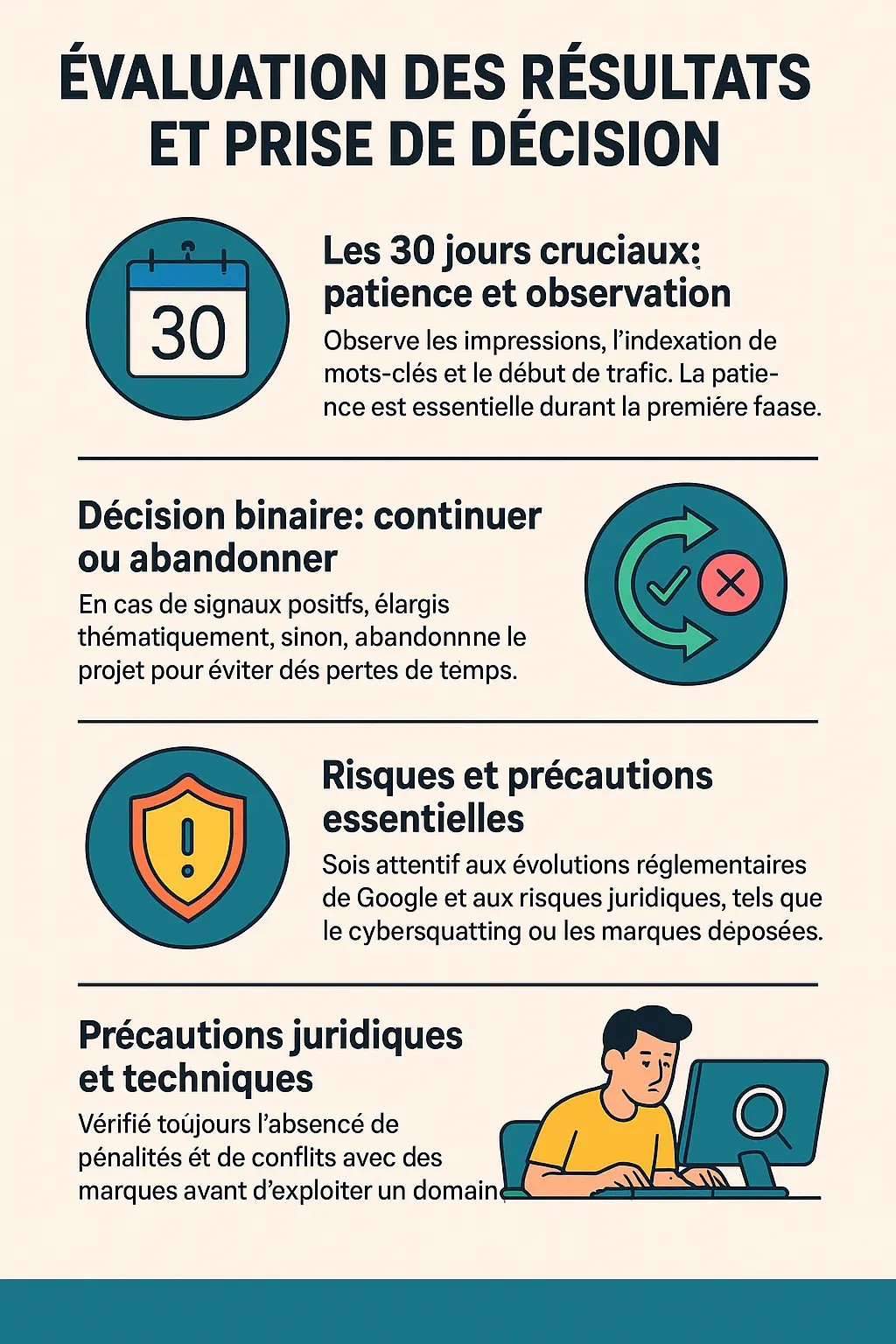
The evaluation happens after 30 days of waiting, the time needed to see the first signals. Three main indicators decide success: impressions showing up in Google Search Console, new keywords getting indexed and the start of traffic generation. A clear data-driven SEO plan keeps those three signals easy to track.
Patience is a critical factor. Results can show up gradually and need regular monitoring without rushed changes that could hurt the process.
I let the content publish quietly. If I did the work well and I get a bit of luck, I should see impressions, indexed keywords and the start of traffic.
Binary Decision: Keep Going or Quit
My monthly review decides what happens next. With few impressions and little traffic, my recommendation is clear: ciao, done, basta. This no-nonsense approach avoids grinding away on domains that will never work.
Conversely, “positive signals” open the door to expansion. Broadening the topic then lets me “reach more buyers” by exploring “related themes that sell”. This growth phase can generate substantial traffic, “from a few thousand to much more, depending on the niche”.
If the site has bounced back, I can widen my niches to reach more buyers by finding related themes that sell. Normally I have a solid keyword base and decent traffic that lets me publish 1 or 2 articles per day with low-competition, high-volume keywords.
Risks and Essential Precautions in 2025
Google’s Policy Changes: What Has Changed
Google’s March 2024 update considerably tightened the rules on using expired domains. This update specifically targets “expired domain abuse”, including buying expired domains to exploit their existing backlinks, reusing domains with established authority to push content unrelated to their history, and domain squatting meant to manipulate search rankings.
This policy hit domain acquisition strategies. Today the practice is riskier. Thematic continuity and content consistency have become necessary factors to avoid penalties.
Google also stepped up its watch on scaled content abuse, including AI-generated content at scale with no added human value. This update is not meant to penalize AI use as such, but rather its deployment at scale without meaningful human input.
Legal and Technical Precautions
I always check for conflicts with registered trademarks. A prior search with the INPI avoids costly lawsuits. Some expired domains carry prior or reserved rights, such as domains with trademarks or place names.
The penalty history has to be checked scrupulously. A domain that got Google sanctions often keeps them, making any SEO effort pointless. I check Search Console as soon as I buy to spot any penalty.
Cybersquatting is a real risk: in the wrong hands, it can hurt your brand image. I always make sure the domain I buy can be used legitimately for my project without infringing third-party rights.
Conclusion: My Proven Method for 2025
After months of testing and experimenting, I can say that expired domains remain a powerful SEO lever in 2025, but they require a methodical approach that respects Google’s algorithm changes.
My method favors quality over quantity, both in domain selection and in content creation. The focus on thematic consistency and patience in evaluation lines up perfectly with what search engines expect today.
Automation through tools like Otomatic democratizes this technique while keeping quality standards. Still, my human oversight remains essential to avoid regulatory pitfalls and maximize results.
This strategy fits perfectly with my time constraints and my family goals. Between my classes in the morning and my writing evenings, I can grow my side business step by step without sacrificing what matters most: my family.
Rigor in evaluation lets me optimize my investments by dropping non-viable projects fast while growing the ones that show potential. This pragmatic approach ensures lasting profitability in an SEO landscape that keeps changing.



Leave a Reply