
Claude Sonnet 4.6 vs Gemini 3 Pro vs GPT-5.2: Which One Actually Codes (and Writes) Better in 2026?
February 2026. Three AIs. One winner, and it is not the one you think.
I put it straight on the table with my partners last week: “If you had to keep ONE single AI tool for coding and writing, which one would it be?” Silence. Because the real answer is not in the press releases. It is in the benchmarks, in the end-of-month invoice, and in what you actually do.
I tested all three. Here is what I found, data, friction and all.
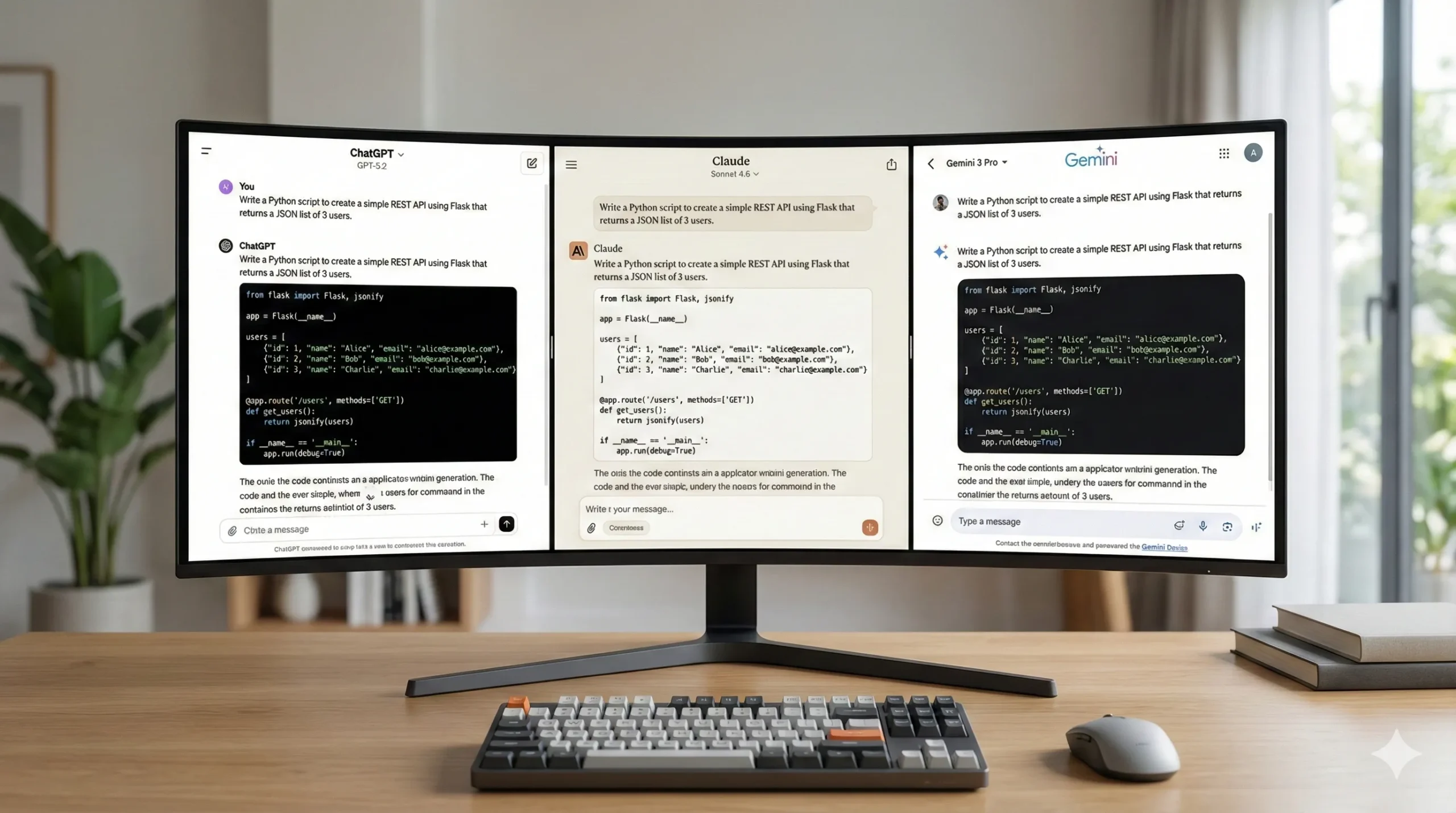
Side-by-side capture of Claude.ai / Google Gemini / ChatGPT running the same coding task
What you really want to know (straight answer)
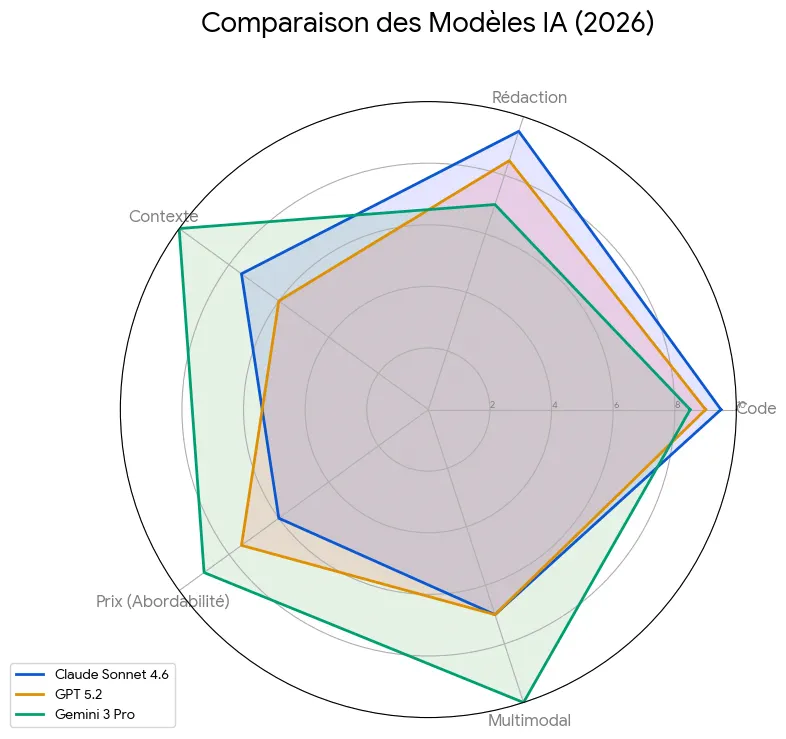
The short answer: Claude Sonnet 4.6 wins on complex code and long-form writing. Gemini 3 Pro crushes everyone on large projects thanks to its 1M-token window. GPT-5.2 stays the most versatile and the best integrated. Your pick depends on your use case, not on a universal ranking.
| Criterion | Claude Sonnet 4.6 | Gemini 3 Pro | GPT-5.2 |
|---|---|---|---|
| Code (SWE-bench) | 🥇 77.2% | 🥉 73.1% | 🥈 74.9% |
| Writing / Docs | 🥇 Natural, fluid | 🥉 Technical | 🥈 Precise |
| Context window | 200K (1M beta) | 1M tokens | 128K |
| Price (input / M tokens) | ~$3/M | $2/M | Variable |
| Multimodal | Text + Image | Text, Image, Audio, Video | Text + Image |
| Best for | Long code & writing | Large codebases, video | Versatile everyday use |
Claude Sonnet 4.6: the new king of code
Released on February 15, 2026, yes, 48 hours ago as I write these lines.
Anthropic dropped Claude Sonnet 4.6 on February 15, 2026 and it is a substantial update. This is not marketing spin: the numbers back it up.
What really changes with Sonnet 4.6:
- SWE-bench Verified score of 77.2%, the best on the market on real bugs
- 94% on Anthropic’s “computer use” benchmark (navigating complex forms, spreadsheets)
- Introduction of the
effortparameter (low / medium / high / max) to balance speed, cost and performance - A 200K-token window (1M tokens in beta)
- “Opus-level” results at a Sonnet price
The difference developers felt in practice: on a 15,000-line codebase, Claude Sonnet 4.6 finds the bug without being told which file matters. It navigates. GPT-5.2 still often asks where to look.
💬 “Sonnet 4.6 is already excellent at complex code fixes, especially when searching across large codebases is essential.” – Anthropic, official blog
Who is it for? Solo developers, code freelancers, technical documentation writers.
Gemini 3 Pro: the quiet giant
Available since November 2025, rolled out to everyone on February 11, 2026.
Google released Gemini 3 Pro on November 18, 2025 and its global rollout has just been completed. It is the workhorse of the three.
Its trump cards:
- 1 million tokens of context (no other model comes close in standard use)
- Native multimodality: text, image, audio, video
- “Best vibe coding model” according to Google itself (I know, easy claim)
- SWE-bench score: 73.1%, third place, but the gap is only 4 points
- The most competitive price among premium models: $2/M input tokens
The truth I learned: when you need to understand an entire codebase in context, Gemini 3 Pro is in a league of its own. No other model does it as well. I loaded a full WordPress project (theme plus custom plugins) and it spotted a hook conflict that would have taken me an hour to find by hand.
On the flip side, and this is the catch, for creative writing or blog posts it remains the most “robotic” of the three. The text comes out technical, clean, but cold.
Who is it for? Development teams, software architects, projects with large files to analyze.
GPT-5.2: the versatility champion
Still the benchmark for everyday use?
OpenAI and GPT-5.2 are in a paradoxical position: they no longer win the coding benchmarks against Claude, but they remain the most used tool in the world with 800 million weekly users.
Its real strengths:
- SWE-bench Verified: 74.9%, solid, second place
- Aider Polyglot: 88% with reasoning mode enabled (+61 points vs without reasoning)
- 400K-token input window (vs 128K for the standard API)
- Best for JavaScript/TypeScript/React: 90-92% accuracy
- Rich ecosystem (plugins, integrations, batch processing)
Reasoning makes all the difference on GPT-5.2. Without “thinking” mode, the gap with Claude widens. With it, it is back in the race.
Who is it for? Full-stack web developers, teams already embedded in the OpenAI ecosystem, professionals who alternate between code and writing every day.
Coding benchmark: the official 2026 ranking
SWE-bench Verified, the industry reference on real GitHub bugs
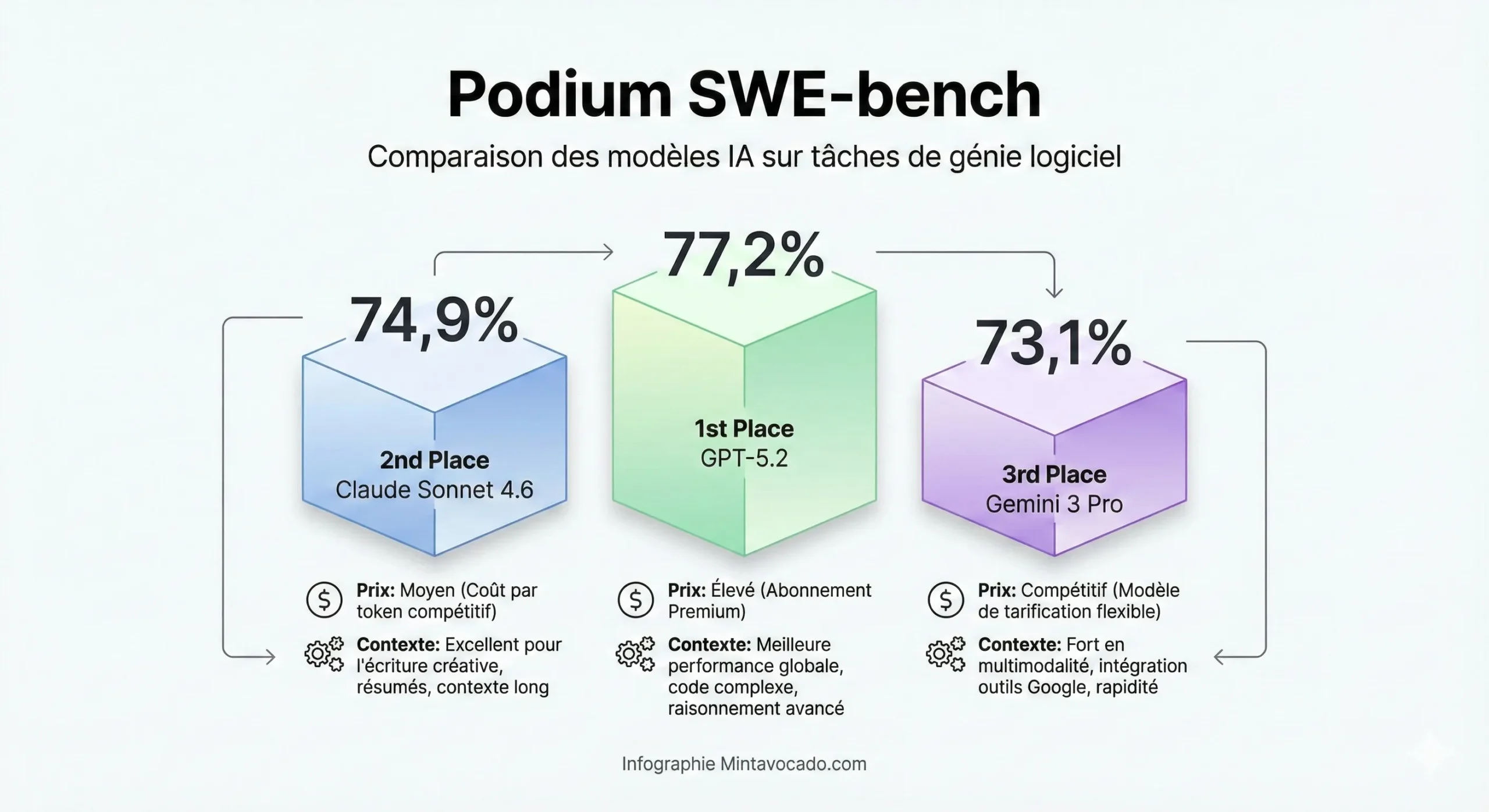
| Rank | Model | SWE-bench | Gap with #1 |
|---|---|---|---|
| 🥇 1 | Claude Sonnet 4.6 | 77.2% | – |
| 🥈 2 | GPT-5.2 | 74.9% | -2.3 pts |
| 🥉 3 | Gemini 3 Pro | 73.1% | -4.1 pts |
What these numbers mean in practice: out of 500 real bugs pulled from GitHub, Claude solves 386, GPT-5.2 solves 374, Gemini 3 Pro solves 365. The gap between first and last is 21 bugs out of 500. We are no longer talking order of magnitude, we are down to details.
Web writing and content: who writes best?
This is the question my readers kept asking all week. Here is my field-tested answer. And because coding and writing do not cover everything, I also put these models through real marketing use cases in my data-driven SEO strategy guide.
Writing ranking (my own test, 1,000-word articles):
- Claude Sonnet 4.6 🥇 – The most natural. The text flows, the tone is human, transitions are smooth. Ideal for blog posts, newsletters, SEO writing. Documentation too
- GPT-5.2 🥈 – Very technically precise. Excellent for tutorials, B2B emails, structured content. Less poetic, but ruthlessly effective
- Gemini 3 Pro 🥉 – Clean, well sourced, but cold. Its real writing talent: summarizing long documents (thanks to its 1M tokens). Weaker on pure creativity
My take as a practitioner: For 80% of my editorial needs, Claude Sonnet 4.6 delivers the best first-draft result. To write from a 300-page PDF, Gemini 3 Pro is unbeatable. To go further, my Gemini vs ChatGPT comparison breaks down the use cases.
The real cost: what you will actually pay
Because the best tool is the one that stays affordable in daily use.
Here is the simulated monthly cost for a team of 10 developers (20M input tokens + 5M output tokens per month):
| Model | Estimated monthly cost |
|---|---|
| Gemini 3 Flash | $25/month |
| GPT-5.2 (batch) | $52.50/month |
| Gemini 3 Pro | $100/month |
| Claude Sonnet 4.6 | $135/month |
What it says: Claude Sonnet 4.6 is the most expensive, and yet it tops the benchmarks. That is the “justified premium” pick, exactly the math I walked through in how I divided my AI bill. Gemini 3 Pro offers the best performance-to-price ratio among high-end models.
Top 3 use cases: the final ranking
Here is how I use them personally, and how I recommend you use them:
🥇 1. Claude Sonnet 4.6 – for everyday coding and writing
The new go-to for professionals who do both. Complex code, articles, documentation. The effort parameter lets you optimize cost per task.
🥈 2. Gemini 3 Pro – for large projects and multimodal analysis
When your codebase exceeds what the others can ingest, or when you need to analyze video and audio on top of text. Unbeatable price for that level of capability.
🥉 3. GPT-5.2 – for teams already inside the OpenAI ecosystem
If you already use ChatGPT, OpenAI plugins, or you ship React/TypeScript in production, do not switch. GPT-5.2 is still excellent and its 74.9% SWE-bench score is far from shameful.
Frequently asked questions (PAA & field feedback)
Is Claude Sonnet 4.6 really better than Claude Opus 4.6 for code?
Yes, according to Anthropic themselves. Sonnet 4.6 reaches performance close to Opus at a much lower cost. For code and everyday writing, Sonnet 4.6 is now the recommended choice. Opus 4.6 is only worth the cost for extremely complex reasoning tasks.
Can Gemini 3 Pro really read 1 million tokens?
Yes, that is the standard context window of Gemini 3 Pro. By comparison, Claude Sonnet 4.6 sits at 200K (1M in beta) and GPT-5.2 at 128K. On big projects, that is the difference between reading one chapter or the whole book.
Which model should I pick for an SEO content strategy?
Claude Sonnet 4.6 is my number 1 pick for SEO writing. It produces the most natural, best-structured text, and handles long editorial briefs very well. GPT-5.2 is an excellent backup for highly technical articles.
Is GPT-5.2 still relevant next to Claude Sonnet 4.6?
Absolutely. GPT-5.2 is second on code (74.9% SWE-bench) and first on JavaScript/TypeScript/React with 90-92% accuracy. Its ecosystem (plugins, batch API, integrations) remains unbeatable. It is not obsolete, it is specialized.
Can I use Gemini 3 Pro for free?
Gemini 3 Pro was rolled out to all users in the Gemini app on February 11, 2026, with higher limits for Google AI Plus, Pro and Ultra subscribers. API access is paid.
What I wish I had known before testing
Three practitioner lessons the usual reviews never mention:
- Stop looking for the universal model. Benchmark gaps (4 points between Claude and Gemini) are too small to justify a single choice. Use case is king.
- Cost matters over time. At heavy usage, Gemini 3 Pro is 26% cheaper than Claude for very similar coding performance.
- The
effortparameter of Claude Sonnet 4.6 changes everything. Settingeffort: mediumfor routine tasks cuts the bill without sacrificing quality. Most users do not know about it yet.
Which of the three do you use every day? Tell me in the comments, and if you have a specific test to suggest, I will run it in my next video.



Leave a Reply