
Google AI Overviews France: it’s live, and CTR will never be the same
Google AI Overviews in France are no longer an end-of-year rumour. In July 2026, Google made it official: AI Overviews and AI Mode are live in France, on mobile, desktop and in the Google app for Android and iOS.
If you run a site, an affiliate blog or a lead gen page, the question is no longer “when?”. It is “does my informational traffic still hold?” and “how do I get cited instead of just ranked”. And if the answer pushes you to diversify, levers outside Google remain: my RollerAds experience report, a push notification network, details what 60 days of campaigns run for affiliate sites are really worth.
What changes at a glance
- Status: Google AI Overviews France (AI Overviews France) and AI Mode (AI Mode France) are live (mobile, desktop, Google app).
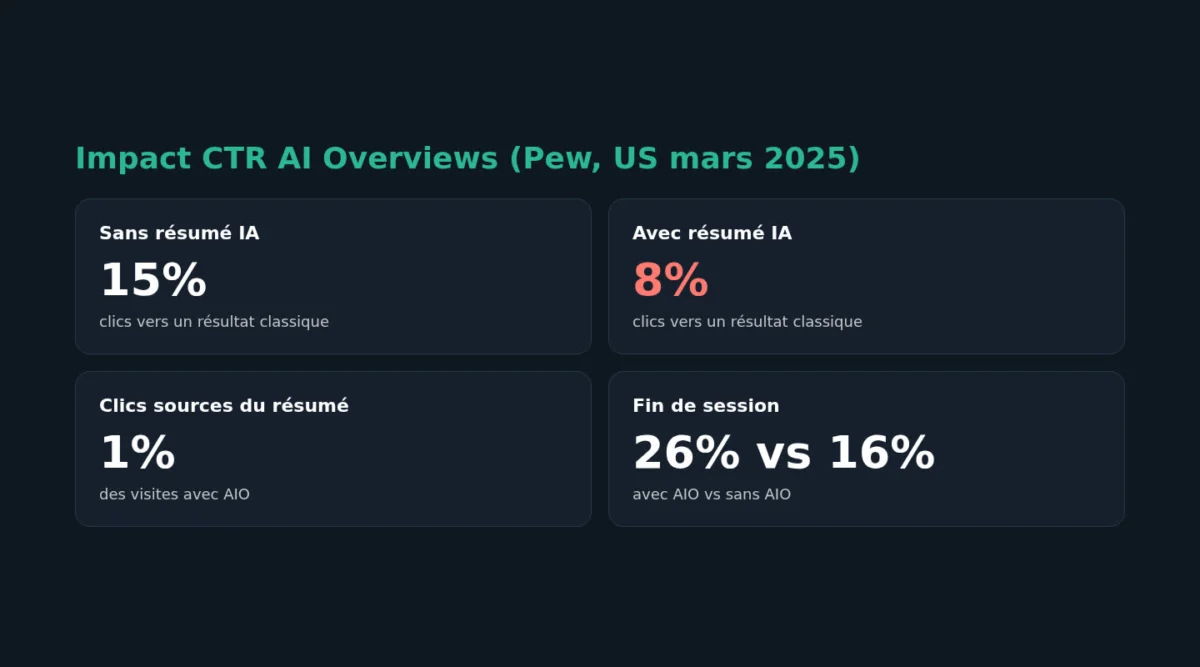
- AI Overviews CTR: in the US, Pew measures 8% of clicks on a classic result when an AI summary is shown, versus 15% without (about half).
- Google AI Mode: sessions run on average 3x longer, with query fan-out, Search Live (voice + camera) and Gemini models.
- Search Console AI control: a France setting lets you include or exclude your site from generative AI features, without touching classic ranking outside AI.
In short: the French exception is over. This is no longer a regulatory calendar topic, it is an operations topic. Countries already exposed show a clear drop in clicks when an AI Overview is displayed.
If you had parked the topic until “late 2026”, that buffer no longer exists. The rest of this post breaks down the impact by publisher type and gives an actionable GEO plan for solopreneurs, with no guru jargon and no promise of magic traffic.
What Google actually launched in France
The official announcement came from Sébastien Missoffe, VP and managing director of Google France, on the Google France blog. Two products arrive together.
AI Overviews
AI Overviews appear when Google judges that a generated summary is useful. You get an overview at the top of the page, with links to go deeper. It is not a separate chat: it is a block embedded in the classic SERP.
The Overview does not appear on every query. In practice, questions, “how / why” topics and long queries are what trigger it most.
AI Mode (AI Mode France)
Google AI Mode goes further. It is the conversational and multimodal experience: text, voice, images, files. Google says it relies on Gemini (Gemini 3.5 is mentioned for multimodal reasoning) and that a session there lasts on average three times longer than a traditional search.
Three technical building blocks to remember:
- Query fan-out: the question is split into sub-topics, then parallel searches are fired at the same time.
- Search Live: voice conversation, with an option to share the camera feed.
- New intelligent search field: a multimodal area for long, mixed queries.
For a publisher, AI Mode changes the game differently from the Overview. The user stays in a thread of answers, with links to continue. Being in that pool of sources becomes a GEO (Generative Engine Optimization) objective, not just an average position target.
The new Search Console control (France)
Google also launched a Search Console control available in France: you can decide whether your site appears in the generative AI features of Search and contributes to their answers.
This control is not a ranking signal for classic results outside generative AI.
According to Google, disabling AI presence does not “punish” your traditional organic SEO. On the other hand, you are out of the citation game in AI Overviews and AI Mode. For most solopreneurs, my default advice is: stay opted in, measure, then decide page by page if a sensitive vertical justifies it.
What already-exposed countries show (Pew data)
The global rollout of AI Overviews began in May 2024. France arrives later, but we are not without a compass. The best public behavioural read remains the one from the Pew Research Center (July 22, 2025): 68,879 Google searches analysed among 900 US adults in March 2025.
The numbers to stick on the wall
| Indicator (Pew, US, March 2025) | Value |
|---|---|
| Share of searches with an AI summary | ~18% |
| Adults who saw at least one AIO | 58% |
| CTR of a classic result link with an AI summary | 8% |
| CTR of a classic result link without an AI summary | 15% |
| Clicks on sources cited in the summary | 1% |
| Immediate session end with an AIO | 26% (vs 16% without) |
| Median summary length | 67 words |
| Question queries (who/what/when/why) → AIO | 60% |
| Queries of 10+ words → AIO | 53% |
| Queries of 1-2 words → AIO | 8% |
Read the 8% vs 15% line carefully. It does not mean “SEO is dead”. It means: when an AI Overview is present, the click to a classic result drops by about half in that US sample.
Another cold lesson: only 1% of visits click a source cited in the summary. Being cited does not automatically equal a click. That said, the brand appears above the fold. Useful if you monetise through something other than the pure pageview (newsletter, brand, delayed affiliate, lead).
Pew also observes that Wikipedia, YouTube and Reddit dominate the sources. .gov sites appear more often in AIOs (6%) than in classic results (2%). The message for any site: proof, primary sources and reference content carry a lot of weight.
A caveat on vertical studies
Several 2025-2026 vertical studies report CTR drops in the 34% to 58% range when an AIO is displayed (the -58% is the most widely covered figure in the SEO press). I quote it with caution: the magnitude depends on intent, device and vertical. Pew remains my methodological reference. Vertical ranges calibrate risk, they do not predict your GSC tomorrow morning.
Among French media (Le Monde, franceinfo, BDM, July 2026), the debate revolves around publisher traffic and the sovereignty of information. For a solopreneur, the question is more down to earth: which of my URLs live off “short answer” intents?
Impact by publisher type: who takes the hit, who adapts
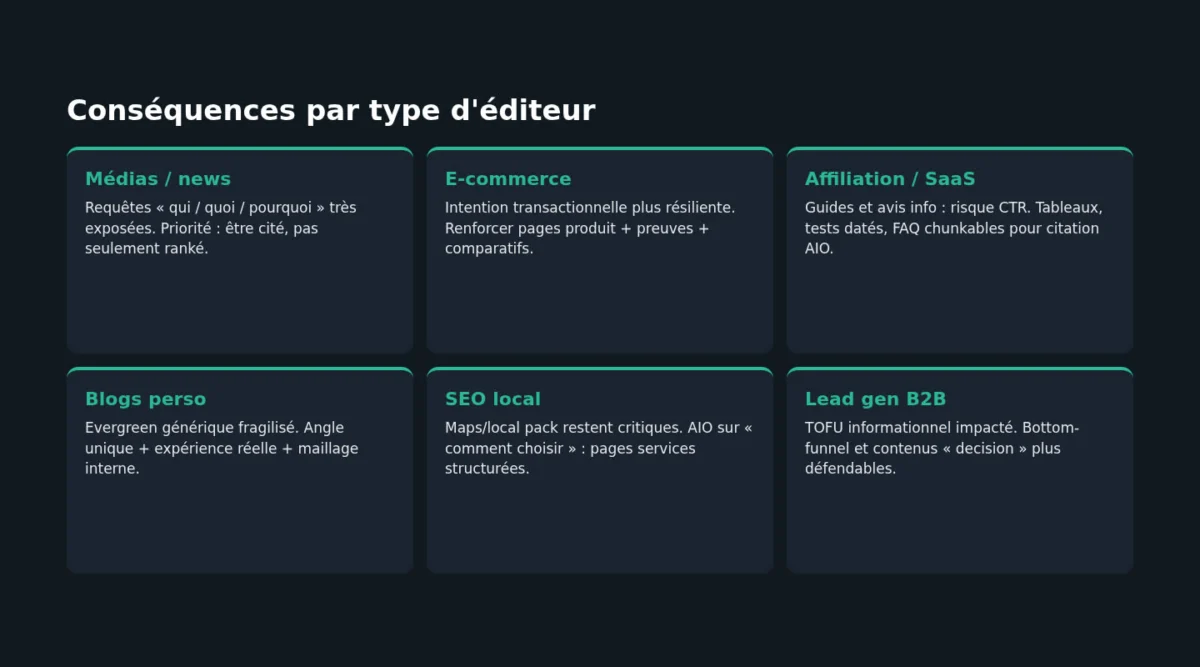
Here is the table I wish I had had on launch day. It is not a numeric prophecy for France (too early for that). It is a risk read based on US patterns and on the nature of the intent.
| Publisher type | AI Overviews risk | What breaks first | Levers that hold |
|---|---|---|---|
| Media / pure players | Very high | News briefs, explainers, “what is” | Investigations, exclusive data, newsletters |
| Personal blogs / generic tutorials | High | Definitions, recycled lists | Experience reports, screenshots, dated methods |
| Affiliate / SaaS reviews | Medium to high | Shallow review pages | Real tests, criteria grids, proof of use |
| E-commerce | Medium | Purely descriptive info pages | Transactional pages, reviews, price, stock |
| Local SEO | Low to medium | Generic local FAQs | GBP, reviews, service + area pages, calls |
| B2B lead gen | Medium | “What is” guides | Assets, calculators, niche use cases, demo |
Media: the most exposed vertical on short news. If the Overview answers in ~67 words, the click to the explainer collapses. Survival comes through angle, field reporting and proprietary data.
E-commerce: less fragile on direct purchase. “Generic buying guide” blog posts, however, take the same zero-click hit as media. Separate product pages from acquisition content.
Affiliate / SaaS reviews: an empty comparison will be digested by the Overview. A dated test, with criteria and limits, has a better chance of being cited and of converting the residual click. AI Overviews CTR is falling, so every visit has to be worth more: email capture, visible affiliate anchor, recent proof of use.
It is also the vertical where the old reflex “rank at position 1 on an info query” becomes insufficient. Position 1 under an AI Overview no longer has the CTR it had in 2023. You need to aim for the citation and for an angle the summary cannot digest in 67 words.
Personal blogs: AdSense model + broad traffic = strong pressure. Niche model + offer = the Overview can work as a brand shop window, provided you are in the sources.
Local SEO: “near me” queries remain highly actionable. The Overview mostly nibbles at generic FAQs, not necessarily at the call to the well-rated local pro.
B2B lead gen: definition top-of-funnel suffers. Templates, scorecards and demos remain defensible. Goal: turn the AI citation into a brand search.
Solopreneur action plan: SEO + GEO in 30 days
No content factory revolution. A realistic 30-day window.
Week 1: map your exposure
- Export Search Console (28/90 days): pages + queries.
- Isolate question queries and queries of 8-10 words or more.
- Flag in red the URLs whose model depends on informational pageviews, then prioritise the pages that actually pay.
- Check the Search Console AI control: confirm the global opt-in.
Deliverable: 20 URLs at risk from AIO and 10 defensible / transactional URLs.
Week 2: make 5 pages citable
For each priority URL:
- Direct answer in the first 80-120 words.
- Question-based H2/H3 aligned with the real questions.
- Scannable table or list (better extracted by models).
- Proof: test date, screenshot, primary source.
- Useful schema: `Article`, `FAQPage`, `HowTo`, `Product` depending on the page, following the JSON-LD schema guide.
GEO goal: become a clean source for query fan-out (see how query fan-out reshapes search), not a vague paragraph.
Week 3: monetise the rare click
If the AI Overviews CTR is compressing, the remaining click has to work harder.
- CTA above the fold.
- Lead magnet tied to the page promise.
- Brand journey: editorial signature, newsletter.
- Fewer definition pages, more decision pages.
In my lab, I also automate SERP monitoring. If you already orchestrate agents, an SEO competitor monitoring stack built on your own AI agents helps you spot early the queries where the Overview is eating your impressions.
Week 4: measure differently
| Old compass | New compass |
|---|---|
| Organic clicks alone | Clicks + brand searches |
| Overall CTR | CTR split between question and brand / transactional |
| Average position | Observed presence in AI Overviews (manual sample) |
| Sessions | Email subscribers / leads / revenue per session |
Run 20 target queries per week in private browsing, on mobile and desktop. Note down: Overview yes/no, citation, position of the blue links. It is handmade. It beats digressions about “the death of SEO”.
AI Overviews vs AI Mode: two distinct fronts
Many people still mix up AI Overviews France and AI Mode France. It is not the same ground. Both are live, but user behaviour and publisher impact diverge.
| Criterion | AI Overviews | AI Mode |
|---|---|---|
| Where it lives | Classic SERP (block at the top of the page) | Dedicated conversational experience |
| Trigger | When Google judges the summary useful | AI Mode entry / deeper dive |
| Usage | Short read (median ~67 words) | Session ~3x longer |
| Publisher risk | Zero-click on short news | Fewer multi-tab journeys |
| Opportunity | Citation + brand | Fan-out source pool |
| Control | Search Console AI control (France) | Same generative AI inclusion logic |
My mental frame:
- AI Overviews = the informational SERP battle.
- AI Mode = the long, multimodal session battle.
GEO complements SEO. It does not replace it.
Mistakes to avoid in the first 90 days
- Panic and noindex to protect yourself from AI: you also drop out of the useful game.
- Bet everything on word count: a hollow wall of text is not more citable.
- Ignore the Search Console AI control: at the very least, know where the cursor is.
- Measure only global traffic: segment intents and page types.
- Believe in magic AIO hacks: citation follows clarity, authority and freshness.
- Abandon transactional content: it is often your safety cushion.
- Neglect primary formats: Pew reminds us of the weight of YouTube, Reddit and Wikipedia in the sources.
What to take away
Google AI Overviews France and AI Mode are not “coming”. They are live. The Missoffe announcement closes the chapter on the French delay. The Pew data on AI Overviews CTR sets the tone: fewer clicks when the summary appears, almost no clicks on the summary sources, more immediate session ends.
This is not the end of search. It is the end of lazy search built on “Wikipedia-light answer” pages. For a solopreneur, the strategy boils down to four verbs: map your exposure, make strategic pages citable, monetise better the remaining click, measure brand and leads alongside sessions.
SEO remains the foundation. GEO becomes the adaptation layer. And the Search Console AI control is a switch you should know, not a panic button.
FAQ SECTION
1. Are Google AI Overviews really available in France now?
Yes. Google announced the effective launch of AI Overviews and AI Mode in France, rolled out on mobile, desktop and the Google app (Android/iOS), after a global launch that began in May 2024.
2. What is the difference between AI Overviews and Google AI Mode?
AI Overviews are a summary embedded in the classic SERP when Google judges it useful. AI Mode is a deeper conversational experience (text, voice, images), with query fan-out, Search Live and sessions on average three times longer.
3. What AI Overviews CTR impact should you anticipate?
In the United States, Pew (March 2025) measures 8% of clicks on a classic result with an AI summary versus 15% without. Clicks on the summary sources remain rare (1%). Vertical studies often quote drops of 34% to 58% depending on context: a risk range, not a French fatality.
4. What does the new Search Console control for AI actually do in France?
It lets you decide whether the site appears in the generative AI features of Search and contributes to their answers. Google states that this control is not used as a ranking signal for results outside generative AI.
5. Does GEO replace SEO after the AI Overviews France launch?
No. GEO (optimisation to be cited by generative engines) complements classic SEO. You still have to rank in the blue links, while structuring content to be a clear source for query fan-out and AI Overviews.


Leave a Reply