
How to Choose a Profitable Affiliate Niche in 2026
Finding a profitable affiliate niche remains the great filter that separates sites generating steady income from those stuck at zero for months. Most beginners rush into a topic that is too broad or too competitive, then give up after 90 days for lack of traffic. The problem is not affiliate marketing itself, it is the initial choice of niche.
This guide describes the method I use and recommend for choosing a niche with real monetization potential, by cross-referencing your interests, search volume, actual competition and the quality of the affiliate programs available. No miracle income promises, just a repeatable framework.
The Short Answer
To find a profitable niche in affiliate marketing, you need to validate five criteria before investing time and money: a lasting personal interest, sufficient monthly search volume (at least 1,000 searches on your main keywords), realistic competition, products with genuine recurring or high commissions, and a clear purchase intent among the audience. If any one of these five elements is missing, your niche will not last.
What Is a Niche in Affiliate Marketing, Concretely
A niche is not just a blog topic. It is the precise intersection between an audience with a specific problem and a set of products that solve that problem. “Health” is a market. “Nutrition” is a segment. “Gluten-free meals for amateur athletes over 40” is a profitable affiliate niche, because the audience has strong purchase intent, dedicated products exist, and the topic is specific enough to limit direct competition.
The classic beginner trap is aiming too broad. The more precise your niche, the easier it is to rank on Google, to speak a language that resonates with your audience, and to recommend relevant products. You can always expand later, once your authority is established. To go further on building a profitable site, check out the action plan for launching a niche site.
The Five Criteria of a Profitable Niche
Before listing niche ideas, you need to understand what actually makes a niche profitable. Here are the five criteria to validate systematically.
Durable personal interest. You are going to write dozens of articles, test products and answer audience questions. If the topic does not genuinely interest you, you will quit before breaking even. Passion is not mandatory, but curiosity is non-negotiable.
Sufficient search volume. A niche with no traffic potential will never generate revenue. Aim for a minimum of 1,000 cumulative monthly searches on your main keywords. Below that, the market is probably too small. You can check these volumes for free with the four-step method detailed further down in this guide.
Realistic competition. A niche with zero competition is often a sign that there is no market. What you should look for is a niche where competitors exist but are weak: poorly optimized sites, dated content, lack of editorial depth. The AI-based SEO tools comparison will help you analyze the competition effectively.
Quality affiliate programs. Before you commit, check that affiliate programs exist in the niche, with decent commissions (ideal: at least 20% or a fixed amount of €30 or more per sale). Amazon Associates is a starting point, but commissions there are low. Direct programs from software publishers, specialized marketplaces or networks like Systeme.io often offer far better terms. For example, check out our complete Systeme.io review, which offers a 60% recurring affiliate program.
Clear purchase intent. The best niche is one where people are actively looking to buy or to solve an urgent problem. “Best accounting software for sole traders” converts better than “what is accounting”. The first reveals commercial intent, the second intellectual curiosity.
The Best Affiliate Niches in 2026
The landscape of profitable niches keeps evolving. Here are the categories that perform particularly well this year, with concrete examples.
SaaS software and tools. B2B software remains a goldmine: recurring commissions, high order values, audiences with budget. High-performing niches: productivity tools for solopreneurs, email marketing platforms, SEO software, content creation tools. Commissions range from 20% to 50% and are often recurring for the lifetime of the subscription.
Health, wellness and fitness. A huge market, but one to approach with care (Google applies the YMYL criterion, Your Money Your Life). Profitable sub-niches: specific supplements, home gym equipment, specialized coaching programs. Favor precise angles over generic topics.
Personal finance and investing. High CPA payouts, products with generous commissions: stock brokers, budgeting platforms, real estate investing courses. Here too, invest in content quality to reassure Google’s algorithm.
Technology and gadgets. Headphones, gaming gear, smart home devices, streaming accessories. High search volume, physical products with decent margins on Amazon and direct programs.
Personal development and career. Online courses, productivity tools, coaching. The affiliate training course niche is itself an excellent example of a thriving market.
Automation and artificial intelligence. This is the rising niche of 2026. AI tools for entrepreneurs are exploding, affiliate programs are multiplying, and the audience is actively searching for solutions. This is precisely Mintavocado’s playground.
The Four-Step Method to Validate Your Niche
Rather than giving you a random laundry list, here is the method I apply to every new project.
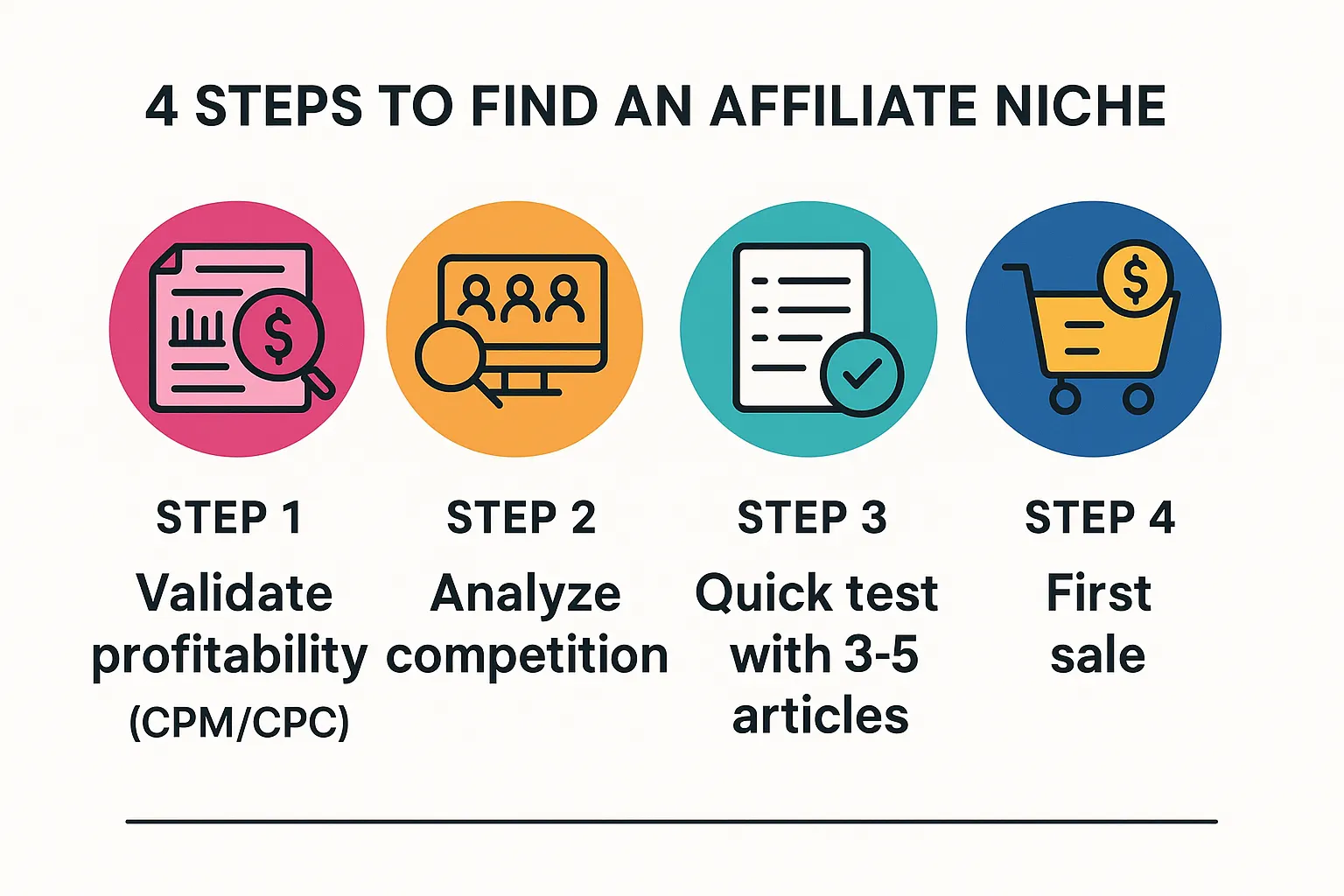
The 4 steps to find a profitable affiliate niche
Step 1: personal brainstorming. List 10 topics that genuinely interest you: hobbies, professional skills, problems you have faced yourself. Do not filter anything, write it all down.
Step 2: volume research. For each idea, check the monthly search volume on the main keywords. Use Answer The Public to discover the real questions people ask, and a tool like SEMrush for keyword volumes and difficulty. You can also use , a workflow I documented in detail.
Step 3: competition analysis. Type your main keywords into Google. Look at the top ten results. Are they high quality? Are the sites old or new? Are the articles in-depth or superficial? If you see recent, shallow sites ranking on page one, that is a good sign: the competition is beatable.
Step 4: checking affiliate programs. Before validating, search for the available programs. Sign up to the marketplaces (Amazon Associates, ShareASale, CJ Affiliate, Awin), check commissions and terms. If no serious program exists, switch niches.
Once the programs are identified, two metrics tell you whether the niche deserves your investment: the audience value (CPM) and the actual commission levels.
The CPM (Cost Per Mille) measures what advertisers pay for 1,000 ad impressions on your site. It matters if you add AdSense or an ad network on top of affiliate income. The gaps between niches are huge:
| Niche | Approximate CPM | Trend |
|---|---|---|
| Education | $5.20 | Stable |
| Technology | $4.19 | Growing |
| Finance | $8 to $12 | Very high |
| Health & wellness | $6 to $10 | Growing |
| Food | Variable | Recent growth |
What this means in practice: with a CPM above $8, every visitor earns you more. With a CPM of $2 or $3, you need five times more traffic for the same ad revenue. A factor beginners almost always ignore.
As for commissions per sale, here are the typical ranges by category:
- SaaS and AI tools: 20 to 30%, up to 40% for the best programs
- Physical e-commerce: 5 to 15%
- Health and supplements: 10 to 30%
- Finance: $50 to $200 per lead in CPA
- Tech and gadgets: 1 to 15% depending on the program
The simple rule: a niche that combines a decent CPM and programs paying at least 15% commission is an opportunity. A low CPM and commissions of $1 to $3 per sale, and the return on investment will be an uphill battle even with traffic.
Last filter: your niche must offer at least 3 to 5 affiliate programs with reasonable approval requirements. To find them:
- Search Google for “[your niche] affiliate program”
- Explore the marketplaces: ShareASale, CJ Affiliate, Impact
- Visit the websites of the leading brands in your niche and look for the “Affiliates” link
Fewer than three serious programs? Warning sign: the niche may exist, but it is not monetizable yet. Move on.
The Mistakes to Avoid at All Costs
Most affiliate marketing failures come from mistakes that can be avoided right from the niche choice.
Choosing a niche that is too broad. “Travel”, “fashion” and “technology” are not niches, they are saturated markets. You will never be able to compete with the established giants. Keep refining until you find a defensible sub-segment.
Ignoring search intent. A niche with lots of informational traffic but little commercial intent produces visitors who never click your affiliate links. Check that the people searching in your niche are in buying mode or in urgent problem-solving mode.
Not testing the product yourself. Recommending a product you have never used is the best way to lose your audience’s trust and generate ridiculous conversion rates. If you cannot test the product, pick another niche.
Relying on Amazon commissions only. Amazon is easy, but commissions are low (1 to 10%) and cookies are short (24 hours). Diversify into direct programs with higher commissions and 30 to 90-day cookies.
Giving up too early. Affiliate marketing requires patience. The first revenue usually arrives 6 to 12 months after launch, sometimes later. If you chose your niche well, stay the course. SEO is a long-term investment, as our SEO guide for beginners explains.
How to Check the Competition of a Niche
Competition analysis is the step where most beginners get it wrong. Here is the practical method.
Before the method, one misconception to clear up. Many people believe the obvious niches (fitness, personal finance, weight loss) are too saturated for a beginner. That is partially true, but it rests on a superficial assessment of the competition.
Perceived competition is: “I search for ‘best VPN’ on Google and I see five huge sites. Impossible to compete.” That is true, for that exact keyword.
Real competition is: “I search for ‘best VPN for remote workers in Canada’ and I land on two mediocre articles from 2021, with no video or detailed comparison.” Now that is winnable.
Beginners who succeed do not chase the big keywords. They target specific variants, long-tail, with genuinely low competition. The opportunity exists: you just need to know how to spot it.

Perceived vs. real competition in affiliate marketing
Start by searching your main keyword in Google in private browsing mode. Look at the top ten results and note: article depth (500 words or 3,000?), the quality of the information, the presence or absence of comparison tables, detailed reviews and recent updates.
For each of those ten results, four questions:
- Is it a massive brand site (Amazon, Wikipedia, major media outlets)? If so, you are probably targeting the wrong keyword.
- Is the article from 2020 or earlier? Outdated content is an opportunity.
- Does it offer videos, comparison tables, detailed use cases? If not, your content can do better.
- Does the site have low authority, with few visible backlinks? Potentially within reach.
Weak, poorly structured results that have never been updated? You have just found a gap: that is where you build. Cross-check with Google Trends to make sure demand is rising rather than falling, and with a difficulty metric: aim for keywords with a Keyword Difficulty below 30 when starting out, ones you can reach without massive authority.
And do not forget your real competitors: not the giants, but mid-sized sites that have an audience without perfect SEO optimization. Look for sites with 10,000 to 100,000 monthly visitors (verifiable via SimilarWeb or Semrush), 10 to 50 referring domains, and content that is two years old without updates. Those are reachable with better, more complete, more recent content.
Then use a tool like SEMrush or Ahrefs to analyze the authority of the ranking domains. If the top ten results all have a domain authority above 60, the niche will be hard to break into. If you see sites with authority between 15 and 30 on page one, it is winnable.
Also check the number of indexed results for your query. Several million results indicate a saturated niche. A few tens of thousands is a positive signal.
Finally, check whether Google Ads appear at the top of the page. If advertisers are paying for those keywords, there is money to be made in that niche.
The Free Tools to Find Your Niche
You do not need expensive subscriptions to get started. Here are the free tools that are enough to validate a first niche.
Google Trends to check that interest in your niche is stable or growing over time.
Google Keyword Planner to get monthly search volume estimates.
Google Search itself, by manually analyzing the “People Also Ask” boxes and related search suggestions.
Answer The Public to discover the exact questions people ask in your niche. Our Answer The Public review explains how to use it effectively.
Forums and specialized groups (Reddit, Facebook Groups) to identify recurring problems and the products people spontaneously mention.
Once your niche is validated and your traffic is growing, you can invest in paid tools. To speed up content production, check out our SEO affiliate content strategy, which explains how to structure your articles for SEO and conversion.
How Much Can You Earn in a Profitable Niche
The taboo question. Here are realistic ranges, based on feedback from the affiliate marketing ecosystem and on my own projects.
A well-built niche site with 50 to 100 quality articles, in a niche with decent commissions (products at €50 or more, or recurring commissions), can generate between €500 and €3,000 per month after 12 to 18 months of consistent work.
Sites that reach €5,000 to €10,000 per month usually have between 150 and 300 articles, an established domain authority (DA 30 or more), and diversified revenue sources: affiliate marketing, display advertising, selling their own products or services.
Above €10,000 per month, you are talking about genuine media businesses with teams of writers and advanced SEO strategies.
What makes the difference between a €500 site and a €5,000 site is not the size of the niche, it is the quality of execution: content depth, perceived authority, user experience, and the relevance of the affiliate recommendations. The blog monetization strategy describes these levers in detail.
On paper, these ranges remain abstract. Here is the real timeline I see among most affiliates who track their stats month by month:
- Weeks 1 to 8: 3 to 5 articles published, little or no traffic.
- Weeks 8 to 16: first visitors (10 to 50 per month), a few clicks on the links.
- Weeks 16 to 24: traffic grows (50 to 200 per month), 5 to 20 clicks per month.
- Weeks 24 to 32: first sale, between $20 and $100 depending on the commission.
It is not instant, but it is predictable. And the first dollar earned changes everything psychologically.

Typical timeline to the first affiliate sale
A concrete example: my first monetized blog (productivity niche for freelancers) generated its first commission in month 6. For the first two months, Google could not even find the site. In month 3, I realized I was targeting keywords that were too difficult: I pivoted to more specific “[tool name] review” queries. In months 4 and 5, about 40 visitors per month, no sales. In month 6, 100 visitors per month, then someone clicked through to Monday.com and created an account: a $50 commission.
The key point: traffic comes before sales. Sales are never the goal of the first quarter. The right question: do I have organic traffic? If yes, sales will follow.
Taking Action: Your Validation Checklist
You have read this far, now it is time to act. Here is your five-point checklist.
- List 5 to 10 niche ideas based on your interests and skills.
- Validate search volume with Google Keyword Planner and Google Trends.
- Analyze the competition by searching your main keywords in Google.
- Check that affiliate programs with decent commissions exist.
- Test a product or service in the niche before you commit.
This checklist validates the niche on paper. Before investing seriously, I recommend a real-world test on a minimal budget, over eight weeks:
Weeks 1 and 2: launch a minimal site. Domain and WordPress hosting for $30 to $50 over three months, a free theme (Astra, GeneratePress free), only the essential plugins. The idea: keep your starting stake at €50. If the niche does not work out, you will have lost €50, not €500.
Weeks 2 to 4: publish 3 to 5 targeted articles. Stay on the long tail: 500 to 5,000 monthly searches, low competition. Bad choice: “best VPN”. Good choices: “best VPN for French expats in Southeast Asia”, “free or paid VPN: why pay?”. Aim for 1,500 to 2,000 words per article, well structured, with a clear affiliate goal toward 2 or 3 products.
Weeks 4 to 8: measure traffic and clicks. Install Google Search Console and Google Analytics. Little or no traffic at first is normal. Here are the signals to interpret:
| Signal | What it means |
|---|---|
| 10 or more organic visitors per month | The niche is indexable, Google finds your articles |
| 2 to 5 clicks on your affiliate links | Your content is useful, visitors click |
| 0 sales | Normal at this stage, the key is having traffic |
Growing organic traffic, clicks on affiliate links, no indexing errors? The niche is validated: you can invest. Zero visitors despite clean technical SEO, or visitors who never click? You have your answer: change niche or keywords. Better to find out after spending €50 than after €500.
If your niche passes the five criteria, go for it. The worst that can happen is learning a tremendous amount about SEO, content creation and digital marketing along the way. And if you want a broader angle, the guide on passive income for freelancers shows how to fit affiliate marketing into a diversified income strategy.
Frequently Asked Questions
What is a profitable affiliate niche?
A profitable affiliate niche is a market segment specific enough to limit competition, with an audience that has clear purchase intent, sufficient search volume (at least 1,000 monthly searches) and affiliate programs offering decent commissions. Profitability depends on the intersection between real demand, beatable competition and monetizable products.
How do you find the best affiliate niche as a beginner?
Start by listing your interests and skills, then validate search volume with Google Keyword Planner. Analyze the competition by searching your keywords in Google. Check the affiliate programs available. The detailed four-step method is described earlier in this guide. Once your niche is validated, go straight to our action plan for launching a profitable niche site.
What are the most profitable niches in 2026?
The most profitable niches in 2026 are SaaS software (recurring commissions of 20 to 50%), specialized health and wellness, personal finance, technology and gadgets, and artificial intelligence automation. The rising niche remains AI for entrepreneurs, with recent and generous affiliate programs.
Do you need to be an expert on the topic to succeed in a niche?
No, you need to be curious and willing to learn. Expertise is built through research, testing products and writing. What matters is providing honest, useful information to your audience. Authenticity beats academic perfection. If you test the products you recommend, you will already be more credible than 80% of affiliate sites.
How long does it take to earn your first dollars in affiliate marketing?
In general, the first revenue appears 3 to 9 months after launching a niche site, and significant income (several hundred dollars per month) between 9 and 18 months. It depends on content quality, niche competition, and publishing consistency. SEO is a long-term investment, not an immediate income.
How many articles should you publish before abandoning a niche?
Count at least 10 well-optimized articles over 12 weeks before drawing conclusions. The quick test of 3 to 5 articles checks that it is fundamentally possible; a serious abandonment decision only comes after 10 or more articles without any traction.
Can you do affiliate marketing without a website?
Yes, via social media, YouTube, or email marketing. But owning a website remains the most durable strategy, because you control your traffic and your content, unlike external platforms that can change their rules overnight. A well-ranked website is a digital asset that grows in value over time. To build a complementary video asset, check out the YouTube guide for business.
The video version of this guide is on the YouTube channel — live tests and hands-on feedback.




Leave a Reply