
Multi-agent editorial factory: the Master Node pattern with Hermes
A single LLM chat does not write an article. It produces one draft, then you replay the same prompt tomorrow. For a solopreneur who wants to publish regularly, the real lever is not a better model: it is a multi-agent editorial factory driven by an orchestrator.
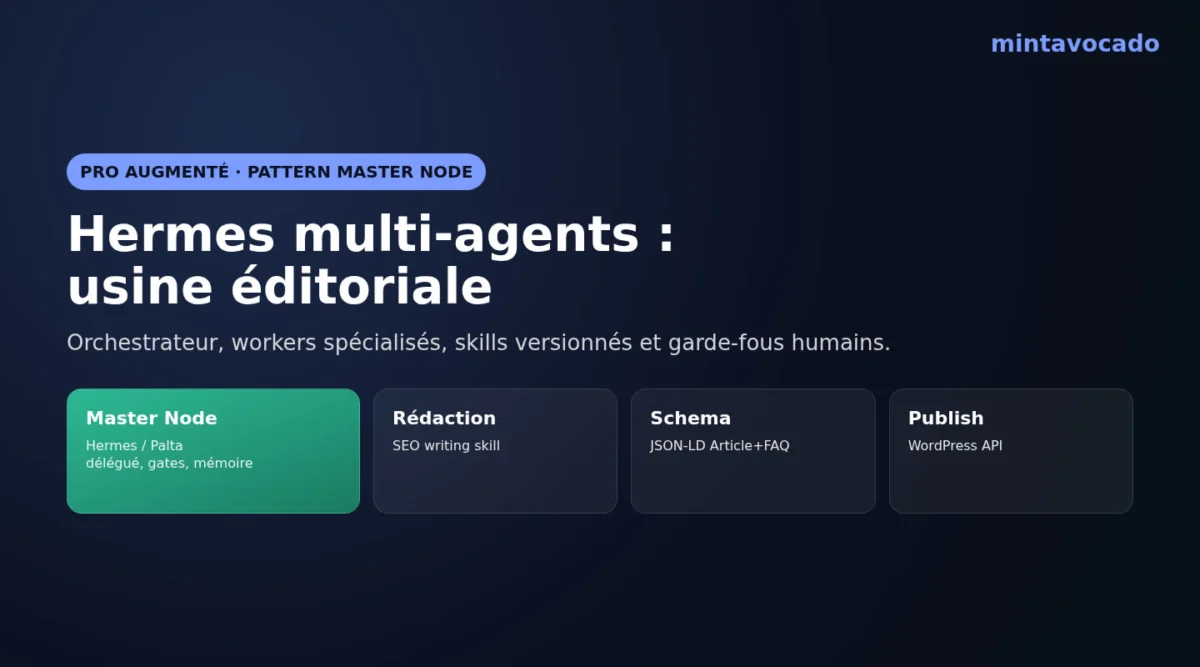
Here is the pattern I use and teach: Hermes multi-agents as the foundation, Hermes Agent as the Master Node, specialised workers, versioned skills that get better after every task, and human guardrails before publication.
The method in brief
- The problem: a single chat mixes research, writing, schema and publishing. Context saturates, quality drops, nothing compounds.
- The pattern: a Master Node (Hermes orchestrator, Palta persona) delegates to isolated sub-agents through `delegate_task`, each one with its own skill.
- The capital: Hermes skills (`SKILL.md` files) are versioned procedures you can patch after every run, not disposable prompts.
- The result: an automated SEO pipeline (brief → writing → Gutenberg → JSON-LD → WordPress) where the human validates, steers and publishes.
This is not “more AI”. It is an architecture for solopreneur content automation built on Hermes multi-agents: Hermes as the data bus, specialised workers, cross-session memory, and a skill improvement loop. If you want to understand the tool surface first, my Hermes Agent review sets the product frame. Here, we talk factory method.
Why a single LLM chat cannot scale a content factory
When everything runs inside one conversation, three frictions always come back.
Context becomes a bottleneck
SEO writing, Gutenberg conversion, schema markup, WordPress API: every step eats context. After a long thread, the model forgets tone rules, invents a detail, or skips a checklist item. You restart. You lose the thread. Context has to be engineered, not hoped for: the same discipline I apply when I connect Gemini to a Drive without exposing data.
Prompts do not compound
A good prompt from today dies in the history. Tomorrow you explain the persona again, the UX H1 format, the em dash ban, the keyword density. Without a stored procedure, every article starts from zero.
No specialisation means no stable quality
A single agent that “does everything” stays mediocre at every step. SEO writing is not block conversion. Non-indexed URL triage is not JSON-LD. Mixing trades inside one role produces blurry output.
Built by Nous Research, Hermes positions itself explicitly as a self-improving agent: a learning loop, skills created from experience, improvement during use, memory that deepens from one session to the next (source: official documentation).
That is exactly what you need to leave “disposable chat” mode and enter factory mode with Hermes multi-agents.
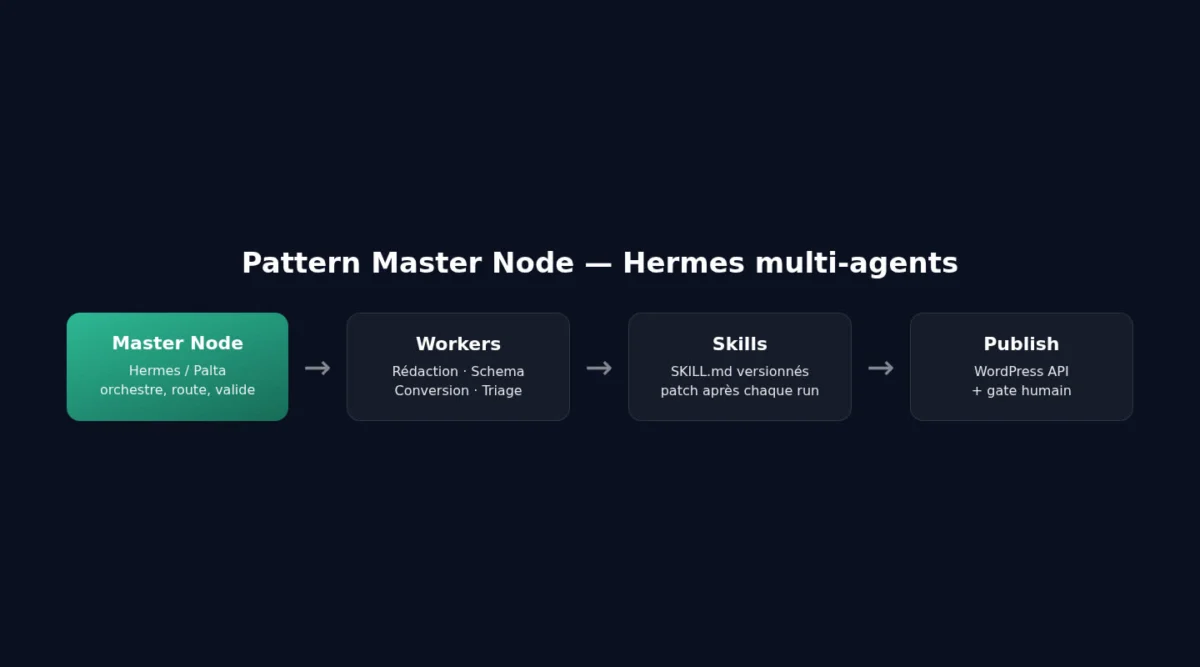
The Master Node pattern (orchestrator vs workers)
The Master Node agent pattern is easy to explain and demanding to hold. It is the core of an AI agent orchestrator worthy of the name.
Role of the Master Node
The Master Node (on my setup, the Palta orchestration persona) does not write the final article. It:
- Receives the brief (keyword, angle, category, anti-cannibalisation constraints)
- Loads the pipeline skill and the guardrails
- Splits the work into isolated tasks
- Delegates to workers through sub-agents
- Assembles the deliverables
- Applies validation gates before anything reaches WordPress
- Patches the skills when a run reveals a recurring trap
Hermes acts as the central brain / data bus: persistent memory, tools (terminal, browser, MCP), cron and a Discord/Telegram gateway to deliver status where you already work.
Role of the workers
Each worker is an isolated sub-agent with a narrow objective:
- SEO writing: Markdown that follows the persona and the WP guide
- Gutenberg conversion: native blocks, metadata stripped
- Structured data: JSON-LD Article + FAQPage
- Triage / on-page: targeted fixes, never a full rewrite
- Illustrations: screenshots, diagrams, visual density
The Hermes docs describe multi-agent delegation: isolated sub-agents spawned for parallel workstreams, batching up to several concurrent tasks through `delegate_task`. That is the technical core of the Hermes multi-agents pattern.
Why “Palta” and not “the AI”
Naming the orchestrator forces mental discipline. Palta is not a magic writer. It is a line chief: it knows who gets called, in which order, with which definition of done. Without that explicit role, you fall back into a single chat.
Skills = versioned procedures (not disposable prompts)
The real asset of an AI editorial factory run on Hermes multi-agents is not the model of the day. It is the Hermes skills.
What a skill actually is
A skill is a procedure document loaded on demand (`SKILL.md`), compatible with the open agentskills.io standard. It follows a progressive disclosure pattern: you only load what is useful for the task, to save context.
In the Hermes docs: skills are the procedural memory the agent creates and reuses. Memory and skills complement each other: memory keeps small durable facts that are always useful; skills store long procedures loaded only when relevant.
Version, patch, improve
After a difficult task, the correct pattern is:
- Run the skill
- Note the trap (e.g. a converter that swallows H2s, a false positive in a check)
- Patch the skill immediately (`skill_manage` / patch)
- Replay the next task with the corrected procedure
This is the learning loop documented by Nous Research: skills created from experience, improvement during use, cross-session persistence. With Hermes multi-agents, your factory gets better every week without rewriting your prompts by hand.
Factory skill examples (business logic)
Without exposing any sensitive infrastructure, the logic looks like this:
| Skill | Worker job | What it refuses to do |
|---|---|---|
| SEO writing | Markdown + persona + FAQ + KW density | Publish, invent numbers |
| Markdown → Gutenberg | Clean WP blocks | Leave SEO TITLE / AUTO-CHECK inside the body |
| Structured data | Valid JSON-LD | Fanciful marketing schema |
| Editorial pipeline | Orchestration, gates, category rotation | Skip visual validation |
| Illustrations | Image density, real sources | Marketing landing page as a screenshot |
The solopreneur does not buy “an agent”. They build a library of procedures that survives model changes. That is the real lever behind an AI editorial factory and behind serious solopreneur content automation.
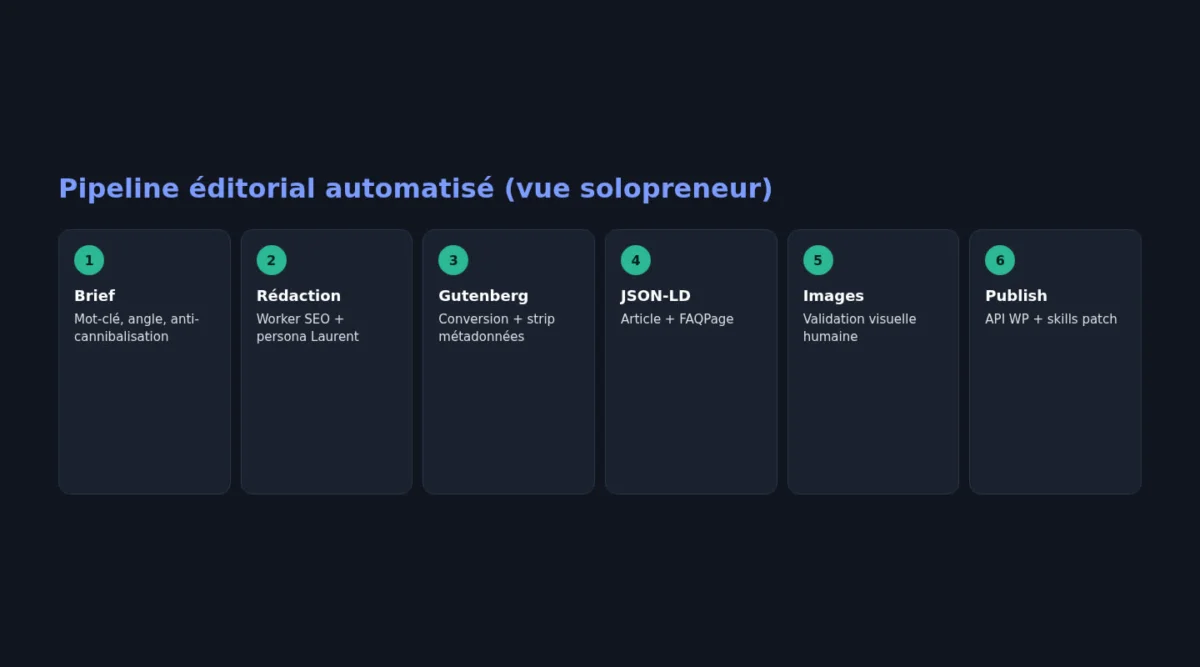
The editorial pipeline in practice (Master Node at work)
Here is the typical flow of a multi-agent editorial factory running on Hermes multi-agents for a WordPress SEO article. The steps are real in the spirit of the pipeline; I do not detail infrastructure secrets or server paths.
1. Brief and anti-cannibalisation
The Master Node first checks that an article does not already exist on the same angle (API search / internal inventory). Same tool, different angle: fine if the differentiation holds. Same intent: consolidate or drop.
2. Writing delegation
The writing sub-agent loads the persona, the style and the Gutenberg guide. It produces:
- SEO title + excerpt + slug
- Markdown body (UX H1 ≠ title)
- Key Takeaways as the first H2
- Table, FAQ, CTA and image markers
- Metadata for the orchestrator (not for the reader)
3. Conversion and cleanup
The conversion worker turns the Markdown into Gutenberg blocks. The Master Node then strips any leftover metadata (SEO TITLE, ASSETS, AUTO-CHECK) that would pollute the public article.
4. Schema + internal linking
The structured data worker generates JSON-LD (Article + FAQPage). External links in nofollow plus a new tab. Internal mintavocado links in dofollow, woven into the body (no “read also” section).
5. Visuals and human gates
Screenshots and diagrams are prepared, then visually validated before upload. No “eyes closed” automatic publishing.
6. WordPress draft + human review
The Master Node pushes a draft, notifies through the gateway (Discord/Telegram). Laurent (or you) sharpens the tone, validates the claims, publishes.
7. Improvement loop
If a check fails three times in the same way, you do not “pay more attention next time”. You patch the skill. That is the difference between a demo and a factory.
This automated SEO pipeline on Hermes multi-agents does not remove the human. It puts the human where their value is highest: intent, angle, truth, publishing.
Master Node vs a single agent vs n8n alone
| Criterion | Master Node (Hermes multi-agents) | Single agent (1 chat) | n8n / automation only |
|---|---|---|---|
| Role specialisation | Yes (orchestrator + workers) | No | Fixed workflows, little judgement |
| Compounding knowledge | Versioned skills + memory | Fragile history | Frozen scenarios |
| Parallelisation | Isolated sub-agents | Sequential in one thread | Technical parallelism, little editorial sense |
| SEO writing quality | High with skill + gates | Variable, degrades with context | Low without an agent layer |
| Continuous improvement | Skill patch after every run | Manual re-prompting | Edit the graph by hand |
| Cognitive cost for a solopreneur | Setup first, then low | High on every article | Graph setup and maintenance |
| Best for | Content factory + SEO ops | One-shots, exploration | Triggers, ETL, webhooks |
Honest reading: n8n remains excellent at gluing APIs together and firing jobs. A single agent remains excellent at exploring. For an AI editorial factory that writes, converts, adds schema and learns, the AI agent orchestrator pattern behind Master Node on Hermes multi-agents wins over time.
Hermes does not forbid n8n. It can connect to it (MCP, webhooks, cron). The point is not to “kill no-code”. It is not to confuse plumbing with an AI agent orchestrator. A Master Node agent judges; an n8n graph executes.
Human guardrails (visual validation, publish gates)
Without gates, a multi-agent factory becomes a high-speed mediocre content mill. Here are the non-negotiable guardrails I apply on my Hermes multi-agents setup.
Gate 1: no invention
Zero invented figures, zero invented reference to a direct client relationship, zero fabricated anecdote. If the source is missing, rephrase without filling the gap.
Gate 2: editorial compliance
Automatic checks before conversion: title ≤ 60 chars, excerpt ≤ 155 chars, zero em dash, UX H1 present, FAQ, table, keyword density, short intro.
Gate 3: Gutenberg integrity
After conversion: H1 at level 1, coherent H2 count, no leftover metadata, image/CTA placeholders handled according to the pipeline stage.
Gate 4: visual validation
Every new visual passes under human eyes before insertion. HTML diagrams, docs screenshots, featured image: Discord validation, then upload.
Gate 5: publish gate
Draft only as long as blocking checks fail. The human decides when to move to publish. The agent proposes; it does not ship in silence.
These gates are what turns Hermes multi-agents from an impressive toy into a production system worthy of an Augmented Pro.
How to reproduce the pattern in 7 days
Goal: a mini Hermes multi-agents factory that produces one draft article end to end, with a skill that improves at least once.
Day 1: minimal Master Node
Install and configure Hermes (see the official Hermes Agent documentation). Define the orchestrator persona (name, mission, what it refuses to do). Enable memory + the notification gateway. While you provision the box, run a quick security audit of your VPS with DeepSeek-V4.1-Flash: a factory that leaks its API keys is not a factory.
Day 2: one writing skill
Write a writing `SKILL.md` with: mandatory structure, bans, output format, checklist. Test it on a short article. Note 3 frictions.
Day 3: immediate patch
Do not keep frictions in your head. Patch the skill. Rerun the same brief. Compare.
Day 4: conversion worker
Add a conversion step (Markdown → CMS format). Automate the metadata stripping. The Master Node chains: write → convert → verify.
Day 5: multi-agent delegation
Split writing and conversion into two sub-agents. The Master Node no longer does the workers’ job. It orchestrates.
Day 6: gates + CMS draft
Add automatic checks + WordPress draft push (or equivalent) + notification. No auto publish.
Day 7: full run + retro
One real article from A to Z. A 20-minute retro: what broke? Which skill to patch? Which gate was missing?
In one week you will not have my full pipeline. You will have the factory reflex and a first operational Master Node agent: orchestrate, version, patch, validate.
FAQ
What is a multi-agent editorial factory with Hermes?
It is a Hermes multi-agents architecture where Hermes Agent plays the Master Node role: it orchestrates specialised sub-agents (writing, conversion, schema, triage) through versioned Hermes skills, instead of doing everything in a single chat.
What is the difference between a Master Node and a simple chatbot?
The chatbot answers. The Master Node splits, delegates, assembles, verifies and compounds. In Hermes multi-agents, it loads procedures, spawns isolated workers, and improves the skills after use.
Do you need to code to set up this pattern?
A minimum of terminal comfort helps. But the core of the pattern is Markdown skills, delegations and checklists. Hermes is open source (Nous Research) and documented for progressive onboarding.
Does Hermes multi-agents replace n8n?
No. n8n excels at API orchestration and triggers. Hermes shines when you need to judge, write, patch a procedure and remember. The two complement each other in a mature solopreneur content automation stack, especially when the AI agent orchestrator stays the brain.
Where does the human remain indispensable?
On the editorial angle, the truth of the facts, the visual validation and the decision to publish. Automation speeds up the chain; it does not carry responsibility for published content.
Final word
The current trap is not a lack of AI tools. It is bolting a single LLM onto a trade that demands a chain.
The Master Node pattern with Hermes multi-agents and Hermes Agent multi-agents changes your posture: you no longer “chat” with a model. You build a factory: orchestrator, workers, self-improving skills, human gates.
If you are a solopreneur, start small. One skill. One delegation. One draft. One patch. Within a few cycles, your automated SEO pipeline and your solopreneur content automation stack become an asset: they improve while you sleep, and they stay under your control. It is the same AI agent practice I test daily and summarised in my guide to AI agents tested in real conditions.
Do not chat with AI. Build with it.



Leave a Reply